How to Get Back on Track!
Who are you again? And what were you supposed to be doing?
Been on holiday? Away for a weekend? Had a few late nights? Been in a creative flow and now your sleep is all over the place? Can’t remember what you were doing? Maybe you’ve missed a few appointments, or maybe you haven’t, but everything feels a bit… unmoored, disconnected.
For ADHDers, this is often where the shame spiral begins: “I was doing so well… why can’t I just start again like everyone else?”
But being off track isn’t failure- it’s part of the rhythm of life. We’ve talked about transitions before- this is another one: getting back in your groove. Not being able to jump straight into full scheduling is okay. Neurodivergent systems can be mutable, rigid, cyclical… we are all different, with different needs. Our energy, interest, and structures ebb and flow, and that’s part of our lives.
Getting back on track isn’t about punishment or rigid routines. It’s about reconnection: with yourself, your systems, and your supports. Here are some things to try
ARIRA- it’s just a pleasing Palindrome
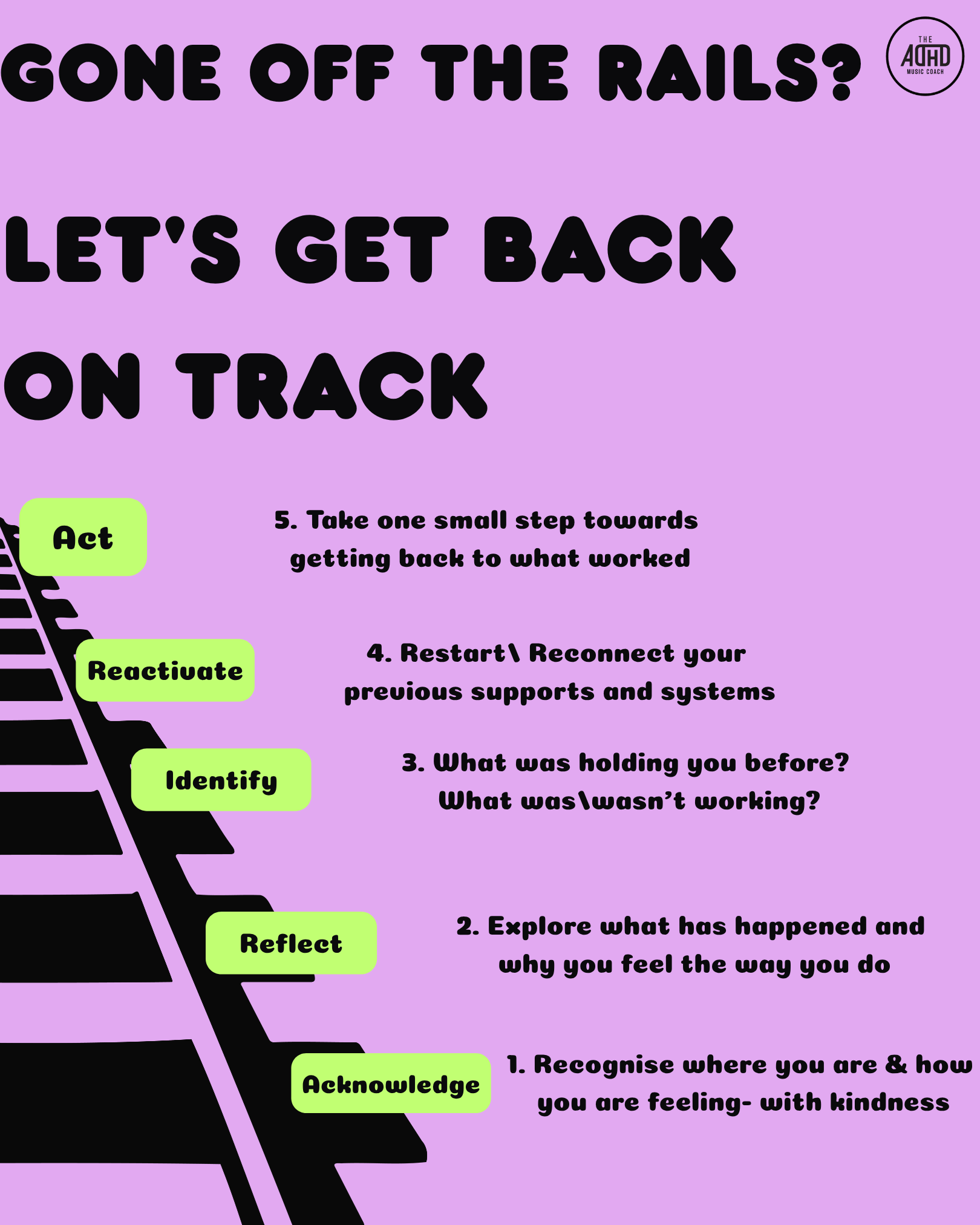
Acknowledge • Reflect • Identify • Reactivate • Act
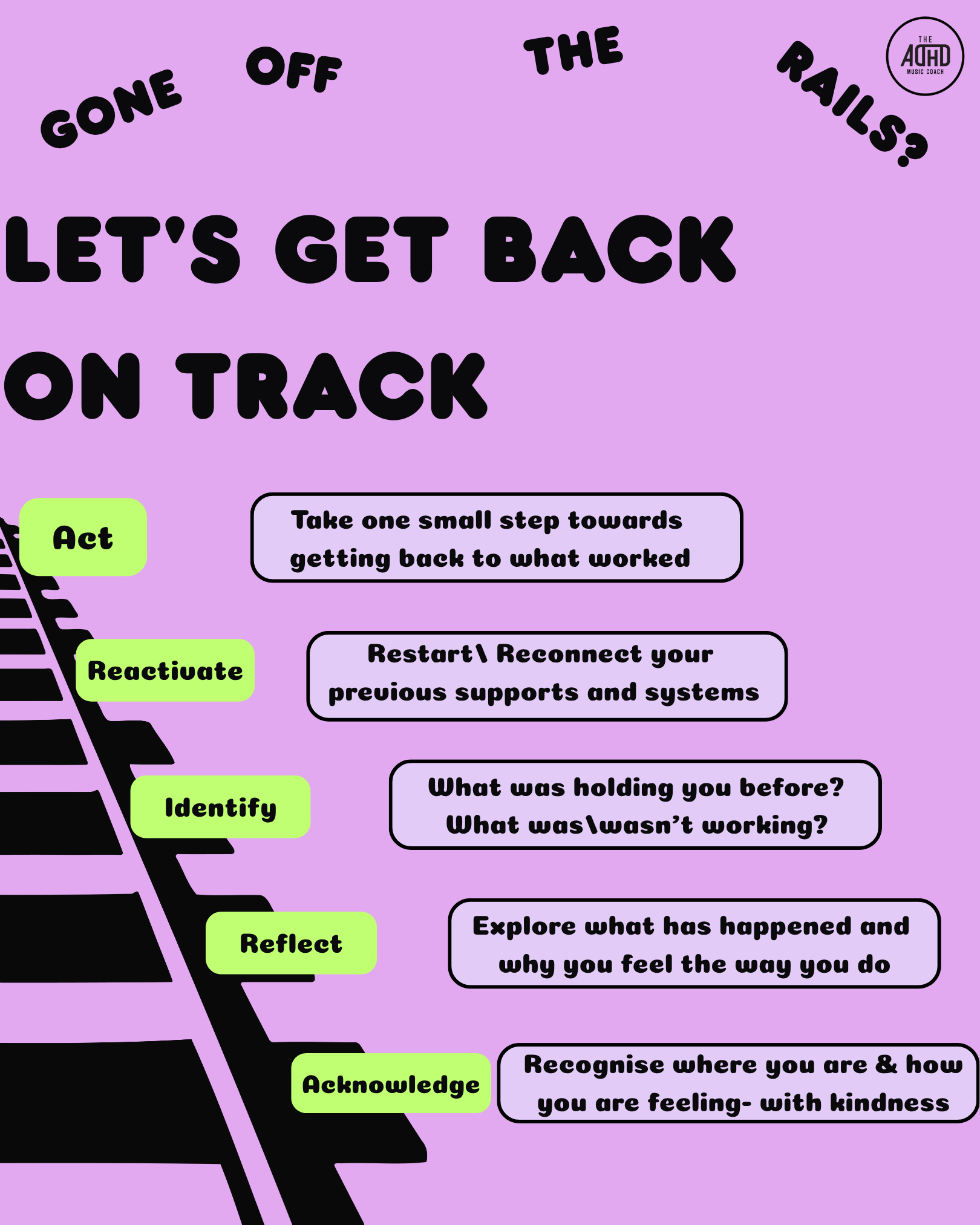
Acknowledge- Reflect- Identify- Reactivate- Act- this is a process we can use instead of entering the shame and recrimination spiral after we’ve gone off track
1) Acknowledge the disruption
Instead of slipping into “I’m so rubbish at life”, try: “I can see why I’m a bit dysregulated. I’m out of my usual pattern. It’s totally understandable to feel frustrated and impatient, and a bit annoyed.”
2) Reflect
Take a few minutes to notice what’s going on. You might journal or voice note:
Hey (me), I think we’re feeling a bit… because we’ve been… and that means… Before, I felt more… and that helped because… One thing I’m realising is…
3) Identify what was holding you before
What were the anchors that helped you feel steady?
Routines, responsibilities, alarms, calendars, accountability, body doubling, exercise, assistant meetings, house/family chats, coaching, therapy, friends- whatever was supporting your structure.
4) Reactivate those supports
Turn alarms and reminders back on. Check your diary for what’s coming up so nothing slips through the cracks. Re-book exercise, accountability, or body-doubling sessions. Reach out to your coach, peer, or friend.
5) Act- start small
After reflecting and accepting where you are, one of the quickest ways to reconnect with your creative self is to, yep you guessed it- create! Pick up your instrument and the lyrics on your piano, or open the last project you were working on. Immerse yourself in what you love doing and who you are, and you’ll find your feet. It’s also okay to not remember what you were doing use your Creative Columbo skills and check comms, photos, videos, or file “last edited” dates to reorient yourself.
Using the Five Daily Pillars
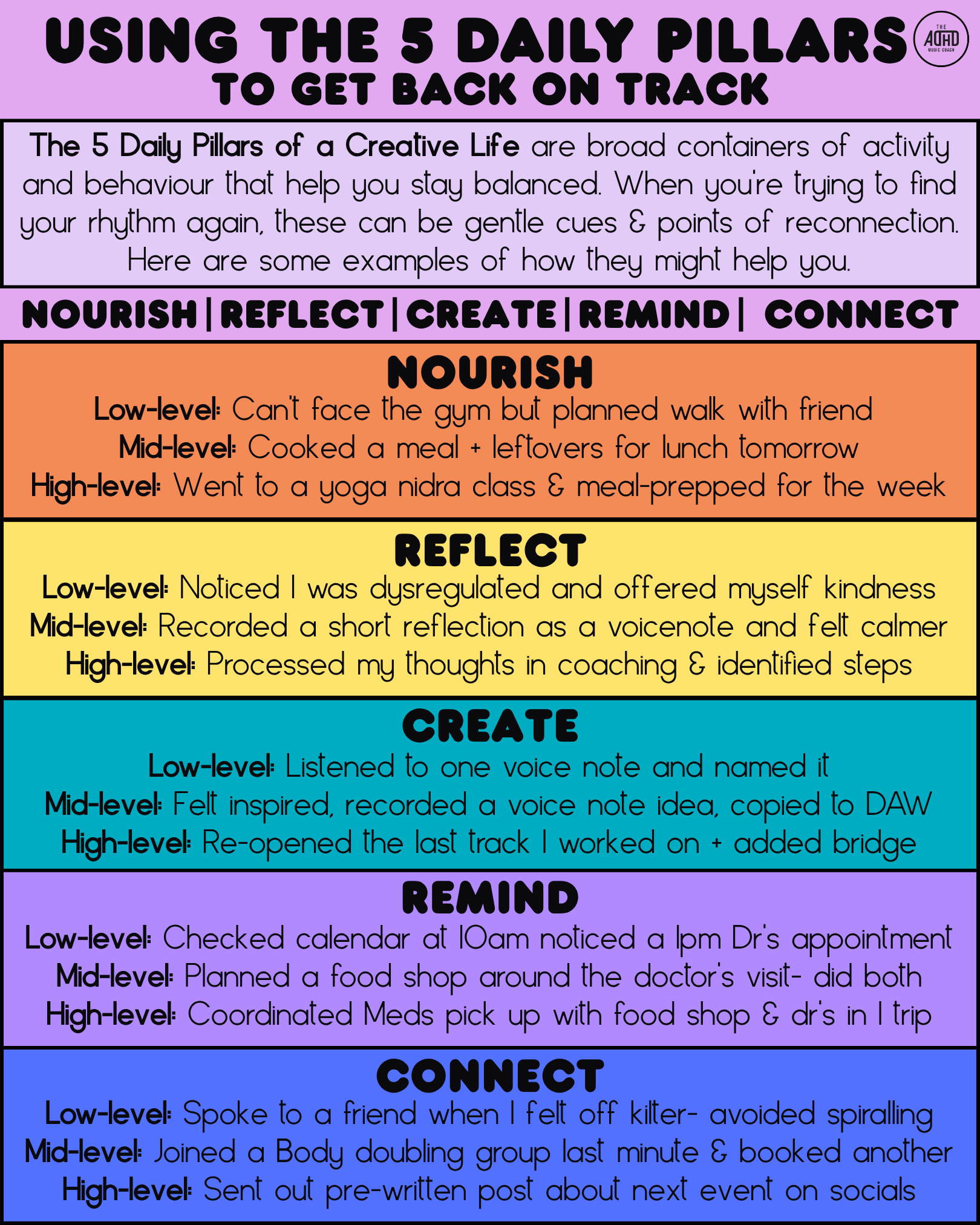
Using the 5 Daily Pillars of a Creative Life can help you find your way back to whatever is normal for you
The Five Daily Pillars are broad containers of activity and behaviour that help you stay balanced.
Nourish activities can include anything that sustains you including nutrition and supplements, movement, meditations and any self care activities,
Reflect activities might include journaling but could also include any kind of processing you do including conversations and the larger reflections you might do regarding your creative direction or goals.
The Create pillar relates to your creative work or art that is integral to everything you do.
Remind can encompass tasks and activities related to remembering what you need to do and includes the tools you use to log your schedule and goals, the systems you put in place and your routines for checking in with these.
Connect relates to any activity or behaviour which involves someone else- including personal relationships but also includes the way we connect outwards about our work and who we share this with including collaborators, clients, fans…
When you’re trying to find your rhythm again, these can be gentle points of reconnection. Here are some examples:
Nourish
Low-level: Can’t face the gym today but booked a walk with a friend for tomorrow.
Mid-level: Cooked a meal and saved leftovers for tomorrow’s lunch; enjoyed the process.
High-level: Went to a yoga nidra class and meal-prepped for the week.
Reflect
Low-level: Noticed I was dysregulated and offered myself kindness instead of berating.
Mid-level: Wrote a short reflection and felt calmer.
High-level: Processed my thoughts in coaching and identified first steps back to routine.
Create
Low-level: Listened to one voice note and named it.
Mid-level: Felt inspired, recorded a voice-note idea, copied it into my DAW.
High-level: Re-opened the last track I was working on and built the bridge section.
Remind
Low-level: Checked my calendar at 10 a.m. and noticed a 1 p.m. appointment - made it.
Mid-level: Planned the food shop around the doctor’s visit - did both.
High-level: Pre-ordered meds and coordinated pickup with food shop and GP in one trip.
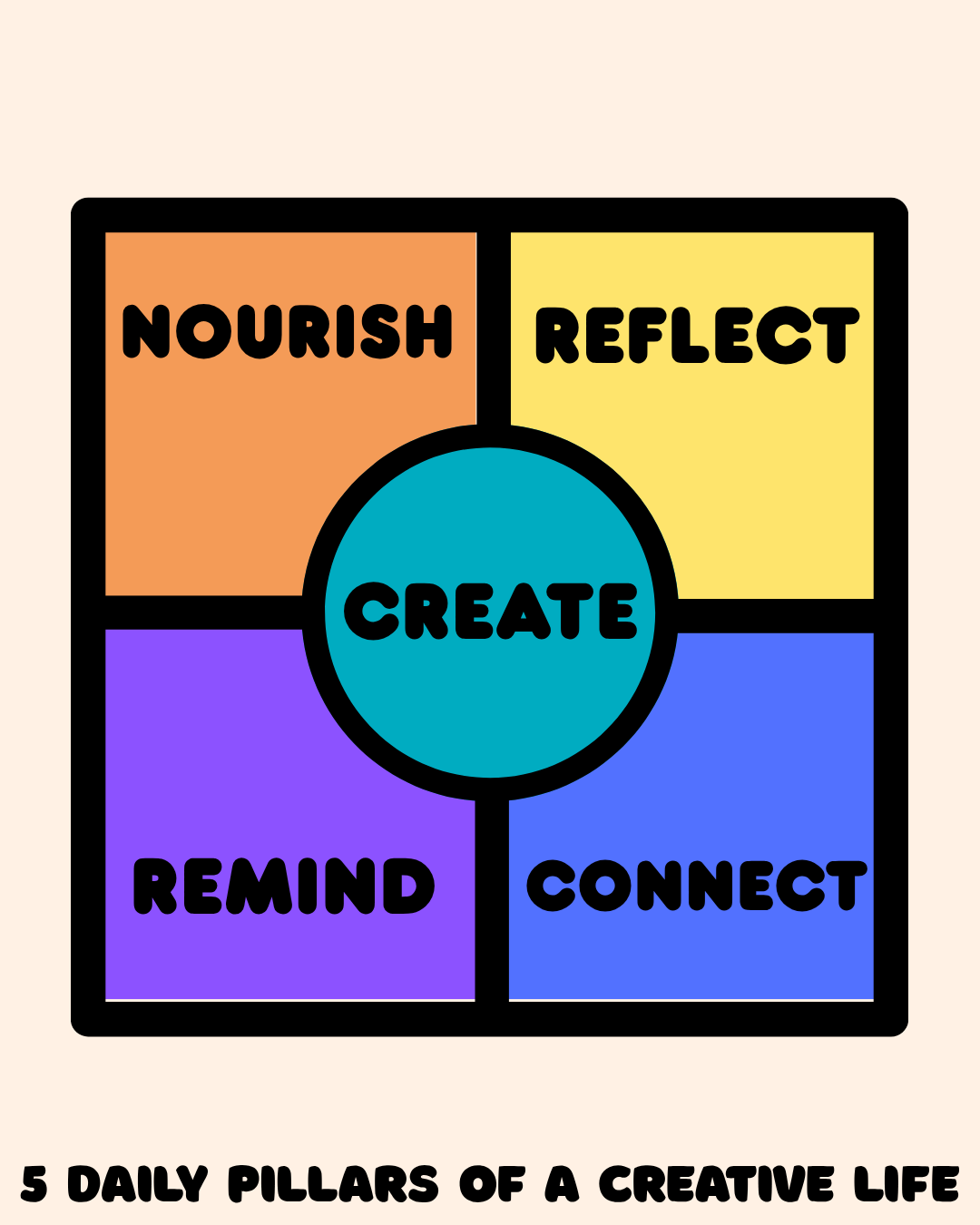
The Five Daily Pillars are broad containers of activity and behaviour that help you stay balanced.
Connect
Low-level: Spoke to a housemate when I felt discombobulated - avoided spiralling.
Mid-level: Didn’t feel up to socialising today but arranged body doubling for Wednesday.
High-level: Sent a pre-written message about my next event on socials and replied to responses.
Finding Your Way Back
These pillars are guides. The only routine or pattern that matters is one that actually works for you, your brain, and your responsibilities.
Many neurodivergent people still hold onto “I should be able to [insert well-known NT productivity hack] and stick to it.” But who says you should? And honestly, how’s that been working out so far? You feel rubbish about yourself and still can’t do what’s expected. Two people can have the same output but arrive there very differently - that’s one facet of neurodiversity.
I’ve been chatting with clients and friends about internalised ableism in ourselves and others. We carry the legacy of this long after we’ve accepted a self/diagnosis. Unpicking all the places we hold ourselves to neurotypical standards is ongoing, but the sooner we uncover, challenge, and dismantle them, the more at ease we can feel with ourselves - and the better we can advocate for ourselves and others.
If you’re thinking, “I don’t want to give myself permission to not try,” that’s not what this is. It’s adding the missing piece:
how does your neurodivergence affect you, and does it make what you want to achieve more or less challenging? What could you do about that?
Many people with ADHD carry deep self-doubt from a lifetime of not feeling good enough, alongside a huge desire to do, create, and share. It’s easier to share from a place of self-belief. Working towards our goals becomes more consistent when we have understanding and compassion, because we’re working with, not against, our neurotype. The battle just to get in the room is smaller when we have knowledge, strategies, and support to shape how we approach the same tasks.
There are many reasons why what works for neurotypical brains does not work for us. Releasing the shame and finding spaces where your brain can be accommodated more often is self-advocacy. If you know what matters to you and keep those things visible (literally - bright Post-its if that helps), you can return to them when you feel lost. Working-memory challenges, needs-based prioritising, and difficulty sequencing mean we sometimes lose touch with our intentions.
Breaks are necessary, and it helps to notice in advance,
“This out-of-routine event will be great, but it may make it harder to jump back in.”
That way you don’t blame yourself, and you know how to scaffold your way back.
Black-and-White Thinking and the Waiting Trap
A client recently told me they’d applied for their dream job, knew the application deadline had closed, and now couldn’t think about anything else while waiting. Our passion and focus can be powerful, but when we fixate on one thing, we struggle to see beyond it. It can feel like an impossible puzzle that must be solved before we can move on- but life doesn’t pause in waiting mode with us.
We have to practise living with the uncomfortable bits. Needing routine and not currently being in routine is one of those places. Acceptance helps us move forward.
You can care deeply about something and still hold space for other possibilities. This kind of flexibility uses ADHD-style distraction for good.
The 8–4–2–1 Reset (a 15-minute exercise)
Ruminate for 8: Set a timer for eight minutes. Let yourself feel completely excited (or however you feel). Write or say everything this opportunity or event would bring until you start repeating yourself or the timer goes off.
Pause for 4: For four minutes, name any possible downsides or other options. Consider how each might affect you and those around you.
Plan for 2: For two minutes, imagine what you’ll do if you don’t get it. What would you need — space, company, fun, a next focus?
Sum it up in 1: In one minute, write or say: I’m feeling really ____ about ____. If plan A doesn’t happen, I can ____ or plan ____. This matters to me, but I’m going to put it down and focus on my next thing because I can’t do anything about it right now.
This helps shift from black-and-white to grey thinking- that spacious middle ground where we can care, but still carry on.
The Compassionate Way Back
Black-and-white thoughts like “I’ve ruined it all now” block self-compassion.
“I can try again”
is more forgiving and gives you a way out. Find one small move towards where you’d like to be. Add a low-level Nourish or Create activity today, then build on it tomorrow.
So how do we get back on track?
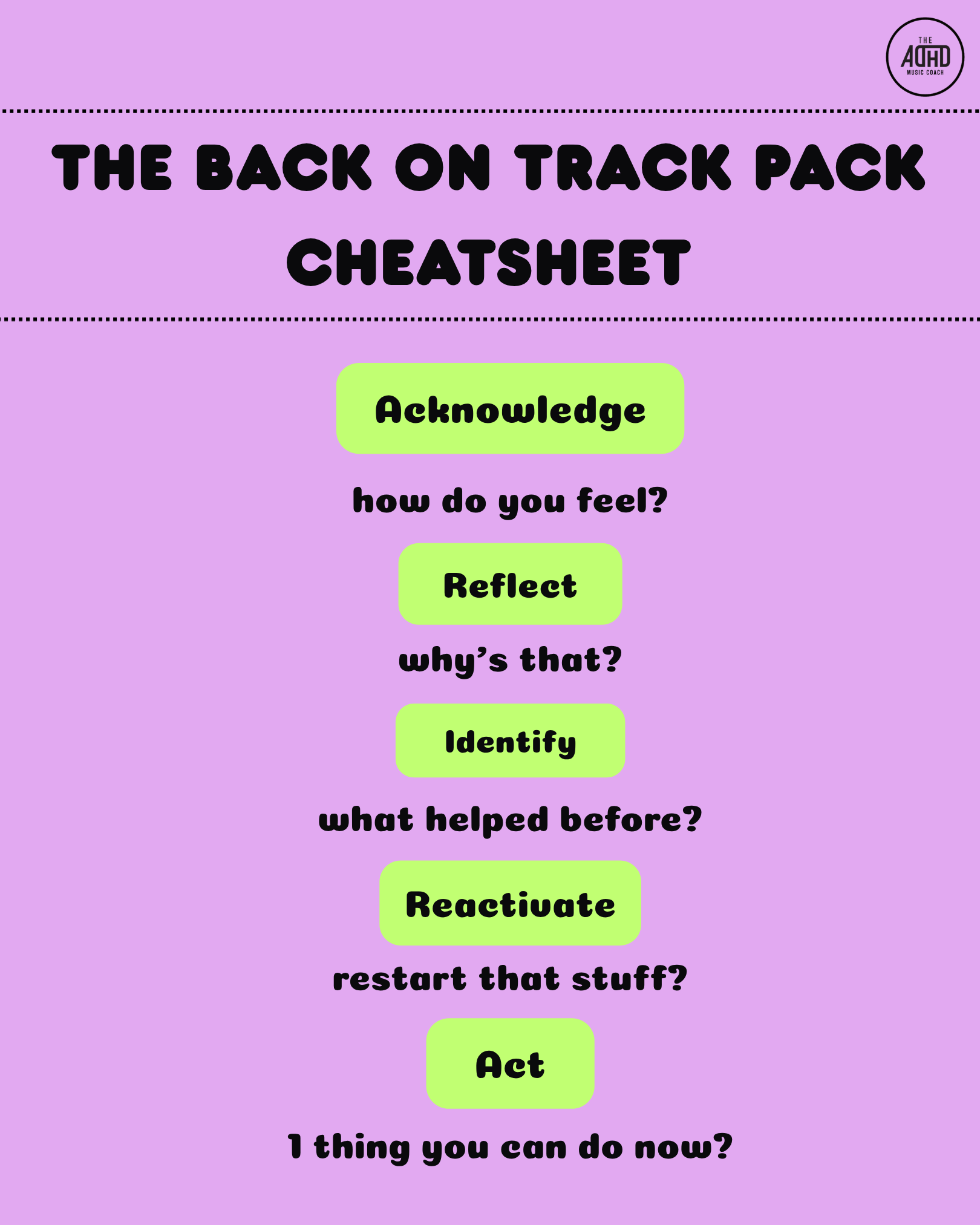
Cheat your way back on track!
Acknowledge that it’s okay to have drifted.
Identify what was working before.
Choose one small step towards it.
Take that step and plan the next.
Rebuild your days as you want and need them.
Bit by bit, you’ll feel more balanced - and back on track.
