It’s Harvest Time- for Your Ideas
Hands up! Who’s got hundreds of song snippets and half-formed ideas lurking in voice notes, old sessions, or notebooks?
Well, heads up- this is a Song Snippet Amnesty.
We’re giving some of them up, working out which ones we want to develop, and gently clearing the creative clutter so we can see what’s actually there.
Idea Overload: The Neurodivergent Dilemma
In a previous blog, we talked about where your strengths might lie as a neurodivergent creative and for many of us, it’s in idea creation.
That’s wonderful… until it becomes a problem. You may have hundreds of recordings and projects but no process for deciding what to do with them next. Capturing ideas is one part of the creative cycle; the flip side is processing and assessing them for potential. And of course developing them into full blown structured ideas is another.
It’s harvest time for all those song snippets- gather up your ideas and see what’s ready to grow.
Overhauling vs Chipping Away
Many ADHDers have what I call the overhauling tendency. We ignore something until it overflows and the visual or physical reminder is what prompts us to act- whether that’s the laundry basket, the washing-up pile, or our creative files.
You don’t notice your clothes need washing until you’ve run out of pants. You don’t wash the dishes until you’re playing plate Jenga or washing up one cup at a time. You don’t clear your voice notes until your phone storage is full.
And then suddenly… you feel like you need a full day to sort everything.
That’s okay- overhauling has its place. But it’s not a strategy you can repeat often, and sometimes we’re seeking something a bit more sustainable and repeatable. So, instead of waiting for the creative equivalent of the laundry mountain, we can borrow a chipping-away mindset.
Chipping-away tendencies might show up as someone who immediately puts a pair of socks in the washing machine and then looks for other things to throw in - maybe even eyeing up that T-shirt you’re currently wearing (true story). Or it might show up in the person who whips away your tea mug between sips, deletes emails straight away, or finishes songs quickly simply because they’re “done with it”.
You might also act on every spark of inspiration without much quality control- which is where an overhauled pile can actually be helpful. Having a few things to compare gives you perspective on quality and preference.
Neither approach is better than the other btw- we need all types of people in the world, and it’s just good to know where you sit and to understand: Aha! that’s why I don’t see a problem until I trip over it…
The 10-Minute Tidy
You don’t need four hours to sort your ideas. Start with ten minutes. Set a timer.
Listen to five voice notes.
Decide: Develop or Ditch.
Rename the ones you’re keeping:
Moonlight – to develop
First time – alt bridge version (keep for reference)
Don’t label anything you’re deleting- just delete it.
That’s it. You’ve already made progress.
Sometimes black-and-white thinking “I don’t have time to do it all, so I’ll do none of it” keeps us stuck. This breaks that loop. This is where adopting a chipping away attitude can be helpful.
Ditch? Or Develop?
When listening back, I do three things:
Listen.
Decide.
Ditch (Delete) or Develop (Keep).
If it’s a dud, delete it. If it’s got potential, rename it clearly.
When I’m deep in a songwriting project, I’ll often have several iterations eg:
“Moonlight initial idea,” “Moonlight 2nd verse” etc.
It can be fascinating to hear where a song started and how it evolved, so I usually keep early versions until the track’s finished then I might get rid of the middle iterations.
I always rename notes as I audit them. It’s a simple way to track processing progress - and it stops me re-listening to the same things over and over- I know which notes I’ve already identified to develop- so there’s a task already done- you could just go in and find something to work on this way and it can become part of your process- go here for previous inspiration- and keep those threads of iteration going.
What Next?
Once you’ve got your “keepers”, decide how to move them forward- here’s some ideas:
Transfer them to your hard drive or DAW.
Sit down with your instrument and develop the next part.
Send a few to your writing partner or bandmate.
Arrange Body-Doubling sessions just for sorting, cataloguing, or developing one idea.
Add a monthly reminder (for example, the 1st of the month = idea review).
If one sparks excitement, jump straight in- open your DAW or grab your instrument and explore it.
Feel blocked?: Listen through a few times and see what gets resparked- What was I feeling here? What was I trying to say? What does it make me feel now?
Grab any sound or start playing and it will come, get something recorded however scratchy and maybe you’ve got a verse, maybe a chorus but what you definitely have is development and progress.
I’m an overhauler myself, so I know the collecting habit. I have a lot of ideas- but like many neurodivergent people I’m also often inspired by the tiniest fragment. Sometimes we have to sit with something long enough to see it through its journey, and that can be hard for us.
But what are we collecting for, if not to use them for something?
As Gustave Flaubert said:
“Anything becomes interesting if you look at it long enough.”
When we capture our snippets of creativity, we’re honouring the muse, our brains, the universe (however you see your creativity flowing through you). We also honour the ideas by giving them a beginning, middle, and end or by deciding:
“Thanks for visiting me, breathy post-dream voice note inspo, but I can’t make out the unforgettable melody from your dreams you were trying to sing at 3 a.m- it definitely doesn’t sound at all like a random butt dial but err… thank you for your service…”
And that’s ok too- we still showed up for it and then sent it on it’s way so we can make room for the other idea babies that will visit- and they will!
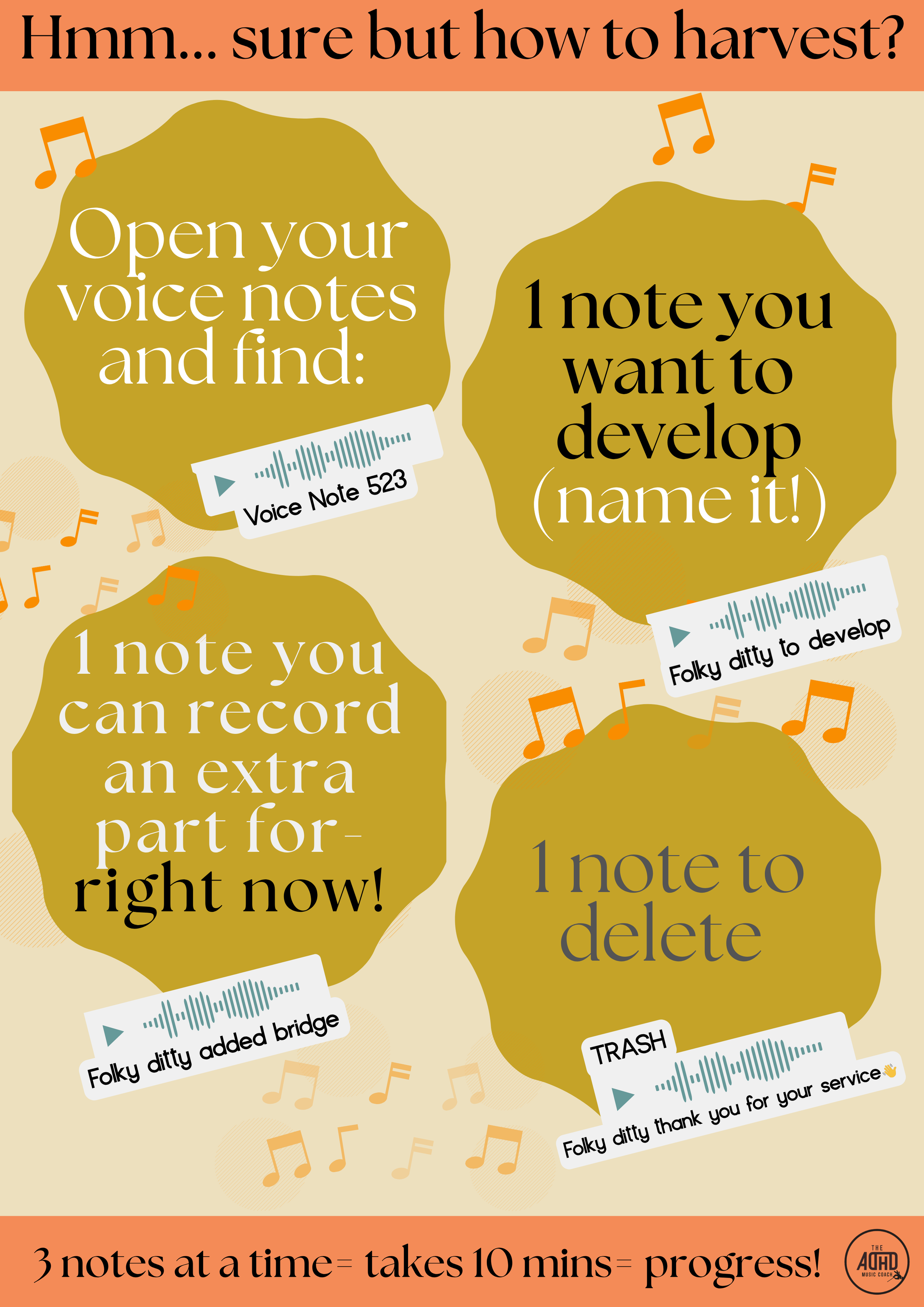
Not sure where to start with all your song ideas? Try this quick “harvest” method- pick one voice note to develop, one to add to, and one to delete.
Extra Tip: Waiting Mode = Harvest Mode
I often use those awkward “waiting” moments for this kind of task- you know what I mean- the space between needing to be alert for but not yet active on the next task or activity. Instead of standing in stasis, try out using waiting time for this kind of task.
Before I leave the house (if it’s one of those days where I’ve got time) I double-check I’m ready, set a timer for when I need to leave, then delve into a few notes. I can do it on my phone with headphones, which also makes it perfect for in-between moments like waiting for a bus, waiting for people to arrive, hanging out laundry or walking the dog (sorry Bert!).
It’s creative admin I might not do otherwise because there are always other things to be doing- but in the waiting mode space and time there isn’t anything else to do except…wait so it’s perfect (other admin can also fit the bill here too).
Make It Manageable
Using those in between moments can be a game changer
Renamed voice notes can carry mental effort for future you
Every micro sort is chipping away at the idea mountain and logging your efforts
When we do this we are not aiming to become admin gurus- we are honouring our creative process and also reminding ourselves that we are wonderfully creative beings who can and do make things- there will be some gold in there.
Your task should you wish to accept it:
Find 1 note to delete, 1 note to develop and 1 note that you add another riff or part to and see where it takes you.
Crack open the vault, go on I dare you!
