What Do People Use Coaching For?
(and what that looks like for ADHD and creative brains)
This is one of the first questions almost every client asks me. I asked it myself when I first started coaching, because even if something has brought you to consider coaching, it can still feel unfamiliar. Coaching is often a new kind of space- one led by you, centered on your own needs- and if you haven’t experienced that, it’s easy to feel unsure about how best to use it.
Ever wondered what coaching actually is- or whether you need it? We will explore what ADHD and creative coaching can look like, what makes it different, and why it can help you reconnect with what really matters.
When Coaching Feels Awkward (and Why That’s Normal)
It can feel like quite a privileged “fancy” space to occupy, and many neurodivergent people new to coaching don’t always know what to do with it.
We might carry experiences of PDA, rejection of authority figures, or at the other end of the scale, people-pleasing and masking. Perceived power dynamics can make things complicated. We may have been taught to defer to those we see as more knowledgeable and then feel shame when we don’t meet expectations- even if, in coaching, those expectations were our own.
It can reactivate old muscle memory: of being at school or past jobs, being misunderstood, and being told we were “difficult”, “doing it wrong” or “not trying hard enough.”
So when someone asks, “Aren’t you going to tell me what to do?” or “How will you make me do that?” it makes sense to me but the truth is, I can’t make you do anything. Coaching relies on coachability- a willingness and readiness to engage with change. That can feel awkward at first, especially when you’ve spent years putting other people’s needs or rules ahead of your own- or have only ever experienced progress through very structured programmes. (There’s a reason ADHDers love courses- the structure +timebox feels safe, predictable, and is externally monitored- eg. if I follow x I will get x- the outcomes from coaching can seem less concrete because they are dependent on you and your individual process.)
Many ADHDers have experienced trauma or repeated invalidation that trained them to silence their natural instincts and self-trust. Coaching can be a space to gently rebuild that trust- to rediscover your own thoughts, feelings, and direction and (re)learn that these are important.
So, What Is Coaching?
At its simplest, coaching is a collaborative process that helps you think, plan, and act with more awareness and intention. The International Coaching Federation describes it as “a thought-provoking and creative partnership that inspires you to maximise your personal and professional potential.”
In practice, that means the coach doesn’t diagnose, fix, or direct. They create structure, reflection, and accountability so that you can identify what matters and move towards it.
For neurodivergent clients, that can mean:
finally having time and language to think about your life without judgement
building executive-function support into real goals
understanding your rhythms, energy, and motivation
reconnecting with self-trust after years of external pressure
The ADHD Coaching Caveat (of course!)
One nuance to my approach to coaching is that, in my experience, ADHD coaching tends to differ slightly from generic life coaching. It often includes elements of psychoeducation, accountability, and skill building. Many ADHDers benefit from working with coaches who are also neurodivergent, or who deeply understand those experiences. It can be incredibly healing to know that other people share similar challenges.
Many of us have grown up feeling weird (we are!) and as if we don’t fit anywhere (not true!). Realising there are others who feel the same- and that some of the more challenging parts of our experience can be supported with practical strategies- helps us move from shame to acceptance, and eventually to advocacy.
For someone newly diagnosed, coaching might be one of the first spaces where they start to see their behaviour through a neurodivergent lens. Untangling patterns and being able to ask, “Is this an ADHD thing?” can be profoundly validating. And sometimes, hearing what has worked for others in similar situations is the first moment of real possibility- you don’t know what you don’t know, right?
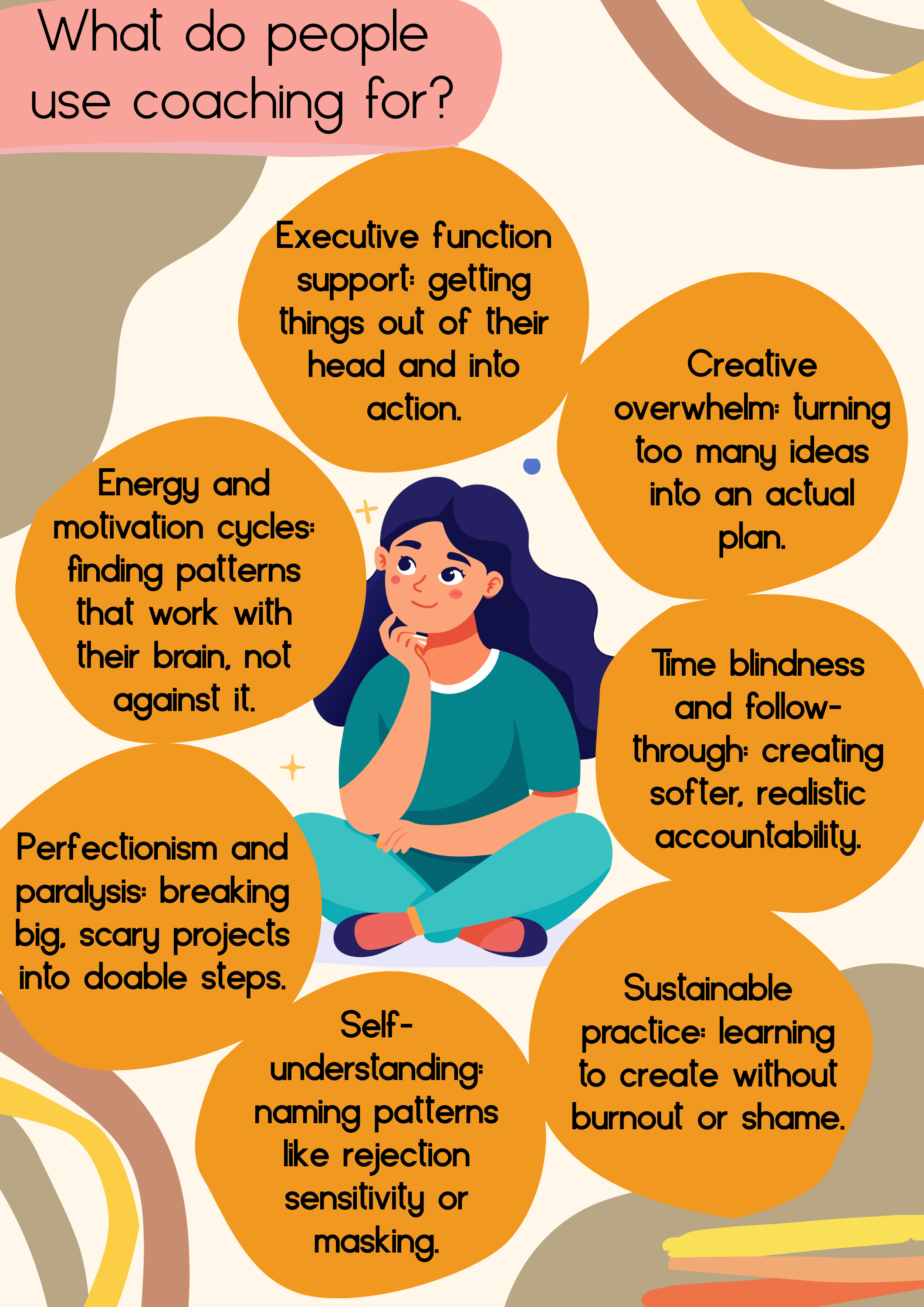
What do people actually use coaching for?
For many neurodivergent creatives, it’s not about fixing what’s wrong- it’s about finding practical support for how your brain really works. From managing overwhelm and perfectionism to building sustainable creative rhythms, coaching can help you bridge the gap between ideas and action
Some of the ways people use coaching:
These are my gentle frameworks for the most common ways that I see people using coaching and how I support those journeys- they are not meant to be seen as the only ways to use coaching but might provide a guideline for those who need it- coaching will always be about exploring what you need each time.
Exploring Identity: Rediscovering Yourself
Some people use coaching to rediscover who they are and what they want- especially after a diagnosis, career change, identity shift or burnout. It’s often about reigniting curiosity and confidence after a long period of avoidance or disconnection.
In my Creative Spark Pathway, this process looks like:
Awakening: reconnecting to creative desire and curiosity
Making Space: clearing physical and mental space for ideas
Permission / Play: exploring freely without pressure to finish
This type of coaching is reflective and exploratory. It’s about remembering what lights you up, rebuilding safety around trying things, and noticing patterns that you might not need anymore.
Reaching a Goal: From Vision to Action
Others come to coaching with something specific in mind- finishing an EP, launching a course, getting through a performance season, or finally pressing “send” on a creative application.
The AMP Creative Output Pathway supports this stage with this process:
Assess: clarifying goals, values, and readiness
Map & Make: breaking the project into steps and taking structured action
Publish / Present: sharing your work in a way that fits your energy and values
This kind of coaching often helps people bridge the gap between vision and execution. It’s less about discipline and more about design- creating scaffolds that make follow-through possible. The majority of my clients come for this type of support- being held through a project process but of course- a wider transformation in their lives usually happens as a result of what is learned.
Sustaining Change: Building Rhythms that Last
Some clients stay in coaching to maintain momentum or to stop oscillating between extremes- the all-or-nothing patterns that so many of us know too well. This work focuses on long-term creative health and self-regulation.
In the Creative Sustaining Pathway the process might be more gentle and cyclical:
Attune: listen to your needs, values, and environment
Maintain / Modulate: keep what’s working and gently adapt what isn’t
Pause & Reward: reflect, rest, and celebrate micro-wins
Here, my Five Daily Pillars of a Creative Life offer a practical lens: Nourish, Reflect, Create, Remind, and Connect. These aren’t rigid routines but adaptable containers and anchors that support balance, creativity, and progress.
Coaching for Musicians and Creatives
In music and creative work, coaching often bridges the gap between artistic identity and everyday function. It can support you to:
finish songs or projects
rebuild confidence after burnout or rejection
prepare for a release, performance, or transition
balance creative, admin, and life tasks
reconnect with play, purpose, or identity as an artist
Clients often come for something concrete and end up exploring something deeper- how they relate to time, motivation, or self-worth. The AMP pathways are designed to meet you in each of these phases, adapting as your creative rhythm evolves.
I use my Occupational therapy training throughout my coaching process- I know that wellbeing can improve through engaging in meaningful activities; I know how to help you identify how to reach your goals and what works for neurodivergent brains. While talking therapies have their place- coaching is a more action oriented space which can be exactly what we need when understanding only gets us so far.
Eventually if we want something different from what we have, we need to do something different- that’s where coaching can be powerful, when you’re ready.
The Bigger Picture
Coaching isn’t about seeing an expert who will tell you exactly what you need and what to do when. It’s about you finally taking up space for yourself, your creativity and reconnecting or discovering who you are.
You get to choose how you want to go forward in the world from now on.
