Skipping to the End- What’s That All About?
Recently I found myself doing something I’ve done since I was a kid: skipping to the end of a book.
It was one I’d pre-ordered months ago and had been looking forward to. A few chapters in, I just had to check one plot point- a “will-they-won’t-they” relationship that has been an integral part of the story since the beginning of the saga. I told myself I’d go straight back to reading it chronologically… but once I knew, I didn’t want to. The tension was gone, but so was the motivation. It’s not the first time (or the last) I’ve undermined an experience I was looking forward to- films, songs but I wanted to look at this through a neurodivergent lens. I wondered what I could learn and how to manage the feeling of having “ruined” something (again); if it really is a form of self sabotage and how we can find a place of peace with our dopamine seeking interest led brains in a world where instant information and gratification is at our fingertips.
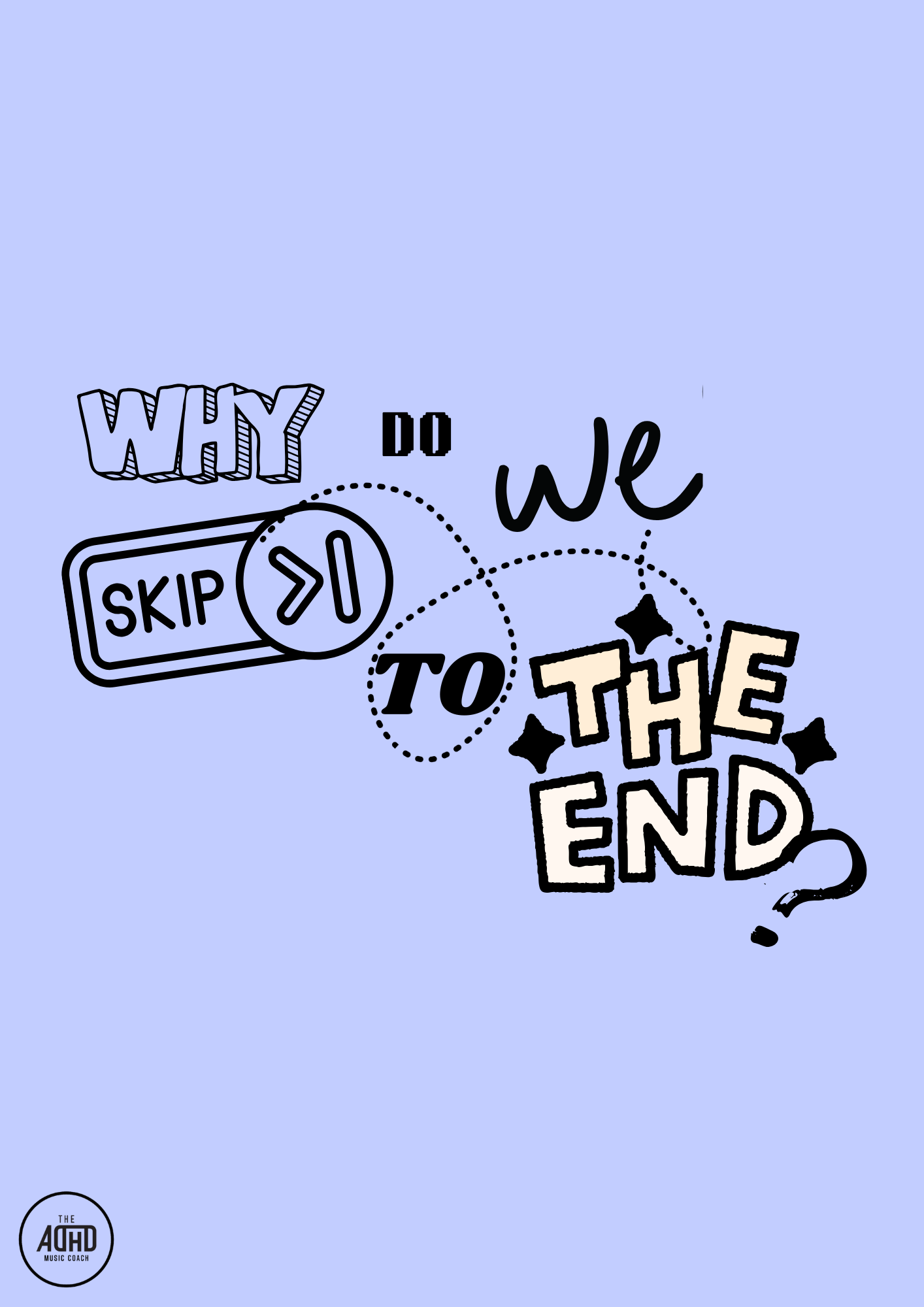
Curiosity isn’t just emotional. It’s neurological.
So what’s this all about? Why do ADHD brains so often need to know now, even when it costs us the pleasure of discovery?
1. The Impulse
That “itch” to know- curiosity mixed with discomfort- is deeply neurological. ADHD brains are wired for interest, novelty, and reward, not for delayed gratification or holding uncertainty.
Unresolved stories (or conversations, projects, or plans) create an uncomfortable loop of prediction and anticipation. Our brains want to close the loop and calm the system- even if that means jumping ahead.
In that sense, we’re not spoiling the story; we’re settling the nervous system.
2. The Brain Bit: Dopamine, Curiosity, and Closure
Anticipation is often unrewarding for ADHD brains. The payoff- the “aha” moment- delivers a dopamine hit that feels regulating, even relieving. But the slow build, the gradual reveal? That can feel itchy, restless, or pointless.
So we seek the end to reduce tension, not necessarily to enjoy it.
That’s why creative work can feel similar: we visualise the album artwork before we’ve finished the song, or plan the gig before writing the set. The brain wants to fast-forward to the reward.
3. Safety, Control, and Black-and-White Thinking
This pattern can start young. For undiagnosed ADHDers, knowing what’s coming next was often a form of safety and self-soothing. Information meant control.
And layered on top of that is black-and-white thinking- the sense that if it’s not finished, perfect, or resolved, it’s somehow “wrong”. So if we discover that the plot is still unresolved, part of our brain checks out. Why keep reading if it’s not going anywhere yet?
But stories- and lives- unfold in shades of grey. Sitting with uncertainty is uncomfortable, but it’s also where richness lives.
4. The Interest-Led Brain
ADHD motivation is interest-based, not importance-based. Once the source of interest changes or once curiosity is satisfied the drive can vanish overnight.
That doesn’t mean you’ve failed. It means your brain has gathered what it needed from that experience.
Sometimes the challenge isn’t to force yourself to care again, but to ask gently:
“What drew me in at first? Is any of that still alive for me?”
If the answer’s yes, reconnect through that entry point. If it’s no- that’s fine too. Curiosity did its job.
5. The “Ruined It” Feeling
That small rush of satisfaction followed by flatness is familiar. It’s not lack of self-control, it’s the dopamine cycle completing before the slower emotional one has caught up.
You haven’t broken anything. You’ve simply ended one loop of curiosity. The next step is learning how to open a new one.
6. Re-engage with the Process
If you do want to rekindle enjoyment:
Shift from what happens to how it happens- the craft, the pacing, the language.
Create exclusivity or constraint- make that book your only one on a trip; give your attention a clear container. You could also try a different format as well as setting- for example an audiobook on a commute or walk might work.
Change the context- new space, new ritual, different sensory input.
Reflect, don’t regret try “What was I looking for by skipping?” and “is it ok if I do the same thing next time?” If not how might you resist?
Each of these reintroduces novelty and agency- two key ingredients for ADHD engagement.
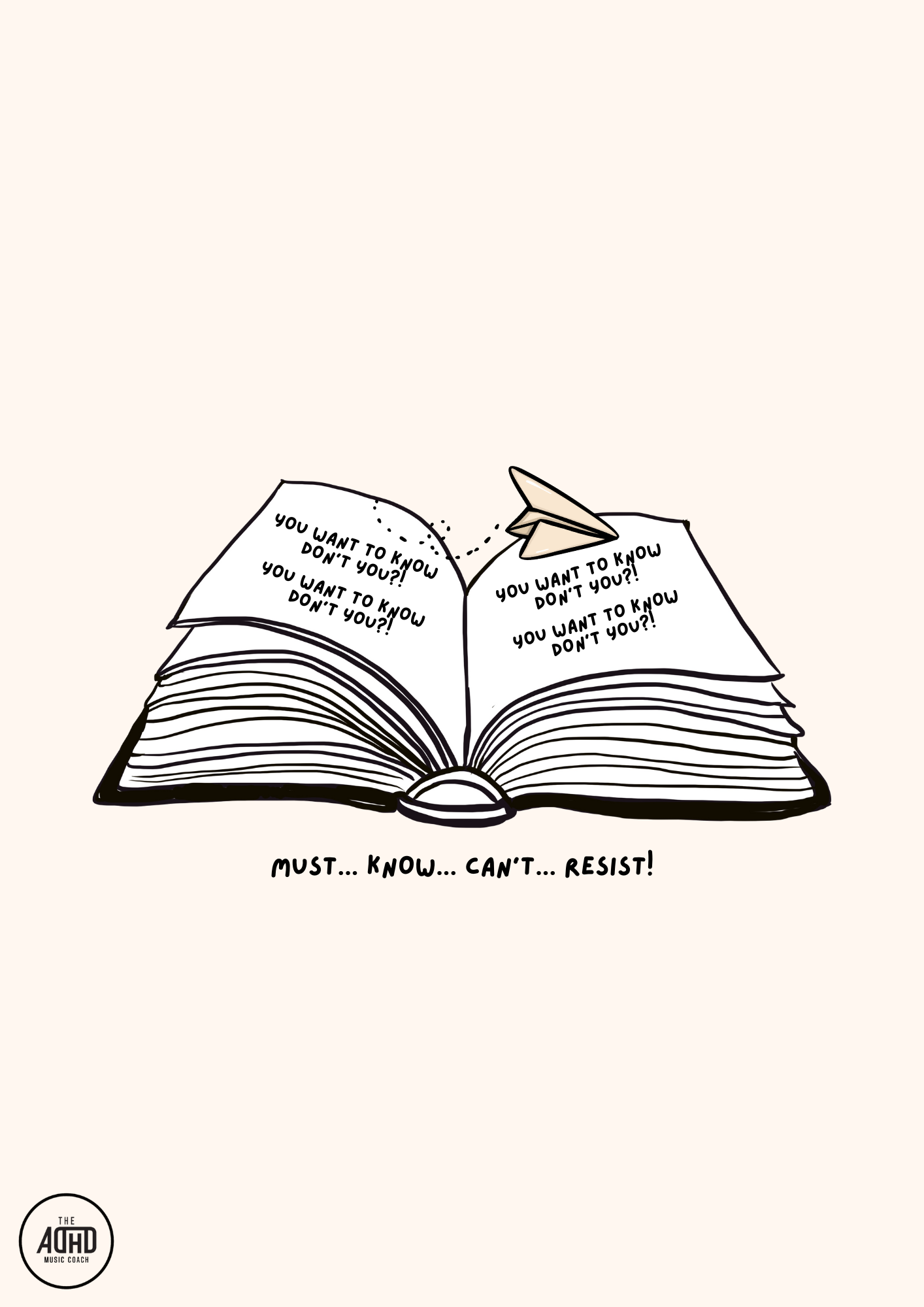
“Skipping to the end isn’t cheating — it’s curiosity looking for comfort. Every story teaches us how to stay present, one page at a time.”
7. Beyond Books: A Creative Mirror
Skipping ahead is part of many creative cycles. We imagine the finished mix, the release day, the applause. Then we lose steam for the middle bit.
Learning to value process pleasure: micro-rewards, reflection points, playful breaks- all help us stay connected without needing the big dopamine spike of “done”. Sharing the process with others can be one way to value this.
8. Slower Culture, Gentle Brains
The world runs on instant access: summaries, spoilers, reels. In that context, skipping ahead isn’t dysfunction; it’s adaptation.
But the “slow” movement- eg. slow reading, slow creativity, slow living- remind us that satisfaction can also be built through savouring.
Savouring activates the same dopamine pathways as novelty- just more steadily. It’s not about discipline or self-control; it’s about nourishing the nervous system through presence.
A note on shame/willpower/self control
I mentioned that I had skipped to the end of books since I was kid exactly for this reason- I didn’t have access to the same amount of information and distraction when I was younger but the impulses and the needs were there- and to repeat: it is not about will power- it’s about wiring. I think the most powerful tool we can utilise when we feel compelled to do something we maybe wouldn’t consciously choose to do is distraction- I mean literally start thinking about something else or stand up, change state and do something else- it’s employing the “not no but just not now” vibe in a gentle way- and it’s something your brain can naturally engage with. And trust me when I say-I totally understand it is not always possible to stage an intervention… but if and when you can- let’s go.
9. Acceptance and Renewal
Sometimes, the truth is simpler: you got what you came for. The curiosity was met. You can thank that version of yourself and the thing and move on.
And if you do want to return, you can start from curiosity again- not guilt.
Ask: What might I notice differently this time, now that I know how it ends?
10. A Gentle Reminder
Skipping to the end can show you what your brain needs- safety, certainty, stimulation and gives you the chance to meet that need more kindly next time.
So whether you turn back to page one or close the book for good, you’re still learning the same thing:
how to live with the story as it unfolds. And have I re-read the book I skipped? Not yet but it’s moved to my Christmas hit list- because this is when I’ve got time off to read a few books- and I’m looking forward to it!
Much Love,
Jemma
