5 Daily Pillars for a Creative Life
What do we need?
Routine and Structure!
When do we want it?
Never! …So what actually works for neurodivergent brains?
The missing scaffolding
When I first researched support for neurodivergent and particularly ADHD creatives during my Masters degree, I realised two things:
There wasn’t a lot of awareness around how neurodivergent needs actually show up in creative careers- for example, how someone’s ADHD might affect their touring schedule, interview prep, or pre/post-performance routine.
If there wasn’t much support out there, I might as well start building it myself.
As an action researcher, I decided to begin with what I knew: what helps me and go from there.
That meant asking some practical questions:
What do I need or want to be able to do?
What skills, equipment and environments support that?
And how might ADHD or neurodivergence affect my ability to carry it out?
I leaned heavily on my occupational therapy training and tools like activity analysis, which helps you understand what an activity actually demands of you; physically, mentally, emotionally, and socially.
What I discovered surprised me. One of my problems wasn’t focus or motivation or that I couldn’t sit still long enough to make music- I could sit still and I desperately wanted to make music. My challenges were around planning my work, communicating and finishing things consistently.
When projects were contained within an external structure: a job, a course, a collaboration, or a deadline- the external deadlines and expectations made it clearer what was needed. Whenever there was clarity, timing, and someone else involved, I finished the work- even if it was right up to the deadline. Left entirely to my own devices? Not so much.
Why so many of us feel adrift
A lot of people with ADHD wonder: What am I supposed to be doing, and when?
Executive function challenges- especially with emotional regulation, memory, planning and prioritising- mean that unless your workload is externally structured, you can end up feeling lost. You know what you want to do, but it somehow disappears in the fog of daily life.
And I’m sure you’ve tried the usual productivity hacks:
Post-it notes!
Whiteboards!
Email yourself!
Diarise “organising time” you’ll never stick to!
These things aren’t wrong, but they rarely stick because they don’t address how neurodivergent brains actually operate day to day.
Introducing:
The 5 Daily Pillars
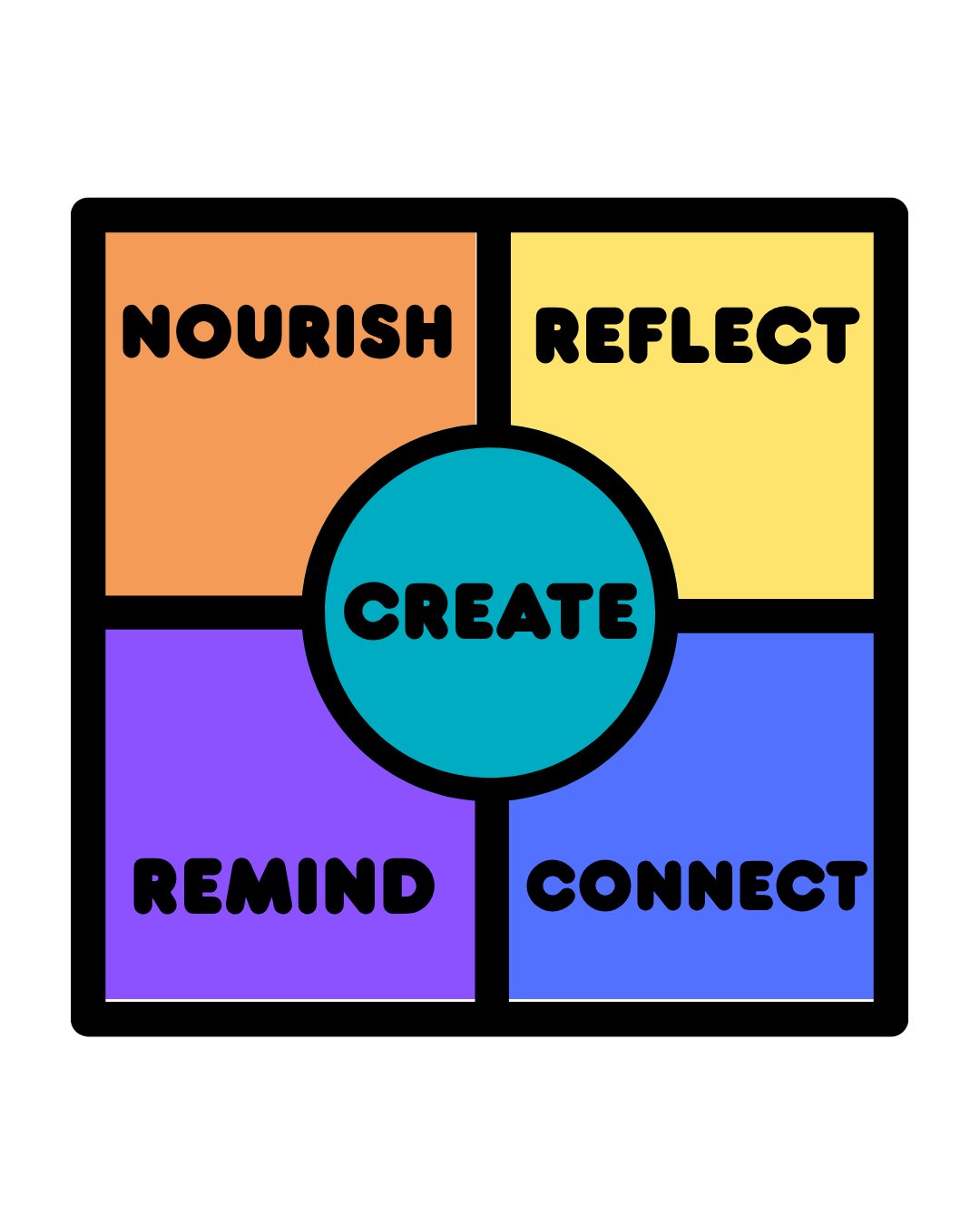
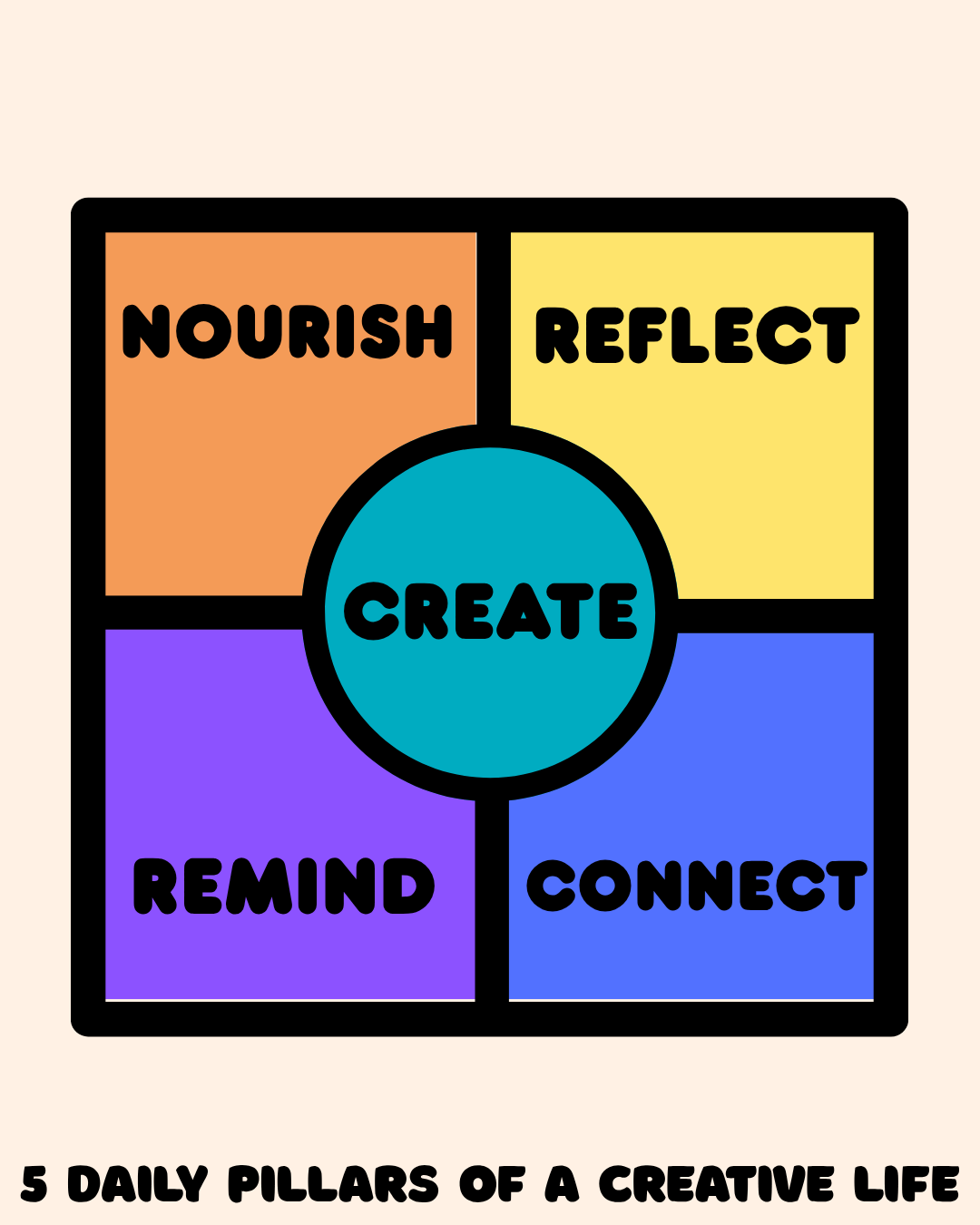
Colourful diagram showing the Five Daily Pillars of a Creative Life arranged in a cross shape.
At the centre: a teal circle labelled Create.
Surrounding it are four coloured squares:
Top left: orange square labelled Nourish
Top right: yellow square labelled Reflect
Bottom left: purple square labelled Remind
Bottom right: blue square labelled Connect
Black background with bold black text.
Over time, I noticed that almost everything I was trying to do- creatively or otherwise- rested on a handful of daily practices. These became the foundation for the system I now use with clients and in AMP Club: The Five Daily Pillars.
Each Pillar relates to a container of behaviour or activity which together form part of a balanced picture of general wellbeing but also have specific functions for keeping you on track with your creative goals:
NOURISH – Body and brain care: food, rest/sleep, hydration, meds, movement-
anything that you find restorative/supportive/essential to your health and wellbeing
You can’t pour from an empty cup; most of these activities are the supporting foundation of you and how you function every day
REMIND – Memory, planning, reminders, cues, routines- this include setting up systems for reminding you as well as updating and checking with them and engaging in things like body doubling which keep you on track
Think of this as your executive-function safety net.
CREATE – The reason you’re here: making, experimenting, finishing, or playing- this is central to your wellbeing- if you identify as a creative being and you are not actively creating or making time to create then it can make us feel at odds with self image and imposter syndrome looms large
Creativity is both the output and the engine of your life — sometimes we can get stuck in planning and admin - of course we need to do bit of everything- but even a tiny bit of creativity every day can be affirming and better than trying to fit in one big push of creative activity.
REFLECT – Awareness, feedback, learning, journalling, noticing what’s working.
Reflection is a tool to be used as it fits you- you might do your reflection through chatting with a friend or writing a note or recording a voice note or doodling, maybe you like to walk and think alone or journal or like to use coaching sessions to gain the insight you need- maybe your reflection is small and internal and not something you notice but this pillar is not about writing a diary- it can mean the way we might need to consider whether a meeting space meets our needs or if you need to ask for a different way of communicating or where you think your branding might need an update and your goals and vision for yourself and your career- this is where pivots happen.
CONNECT – Relationships, community, co-regulation, collaboration, clients, peers, fans- communicating outwards about yourself and your work
You might need peace and quiet to work but seeking colleagues to bounce ideas off is important- creative energy is contagious when shared and sharing your work out with others is also important and should be a more or less daily activity even if these are scheduled in advance. Using our connection to needed people (at the right time for us) and using external motivation as a tool is important- whether it means you only take on work that is fully commissioned by others or do all your work sprints in accountability or body doubling groups- we need other people.
How the pillars interact
Our wellbeing depends on many factors, but for creative people, creating most days is essential — even in small ways. So while “Create” might feel like the most obvious pillar, the truth is they all work together.
You can create all day but never share your work (missing Connect).
You can plan and plan (Remind) but never make or rest.
You can get caught up supporting everyone else (Connect) and forget to Nourish yourself.
You can spend hours Reflecting but never take action.
Or you can focus on your body and routines (Nourish + Remind) and still feel unfulfilled if you’re not expressing yourself creatively.
The five pillars give you a way to check in with yourself:
Have I touched on these today? What do I need right now?
For neurodivergent people, this flexible rhythm works far better than rigid “do the same thing every day at the same time” systems. It creates a sense of balance without expecting uniformity.
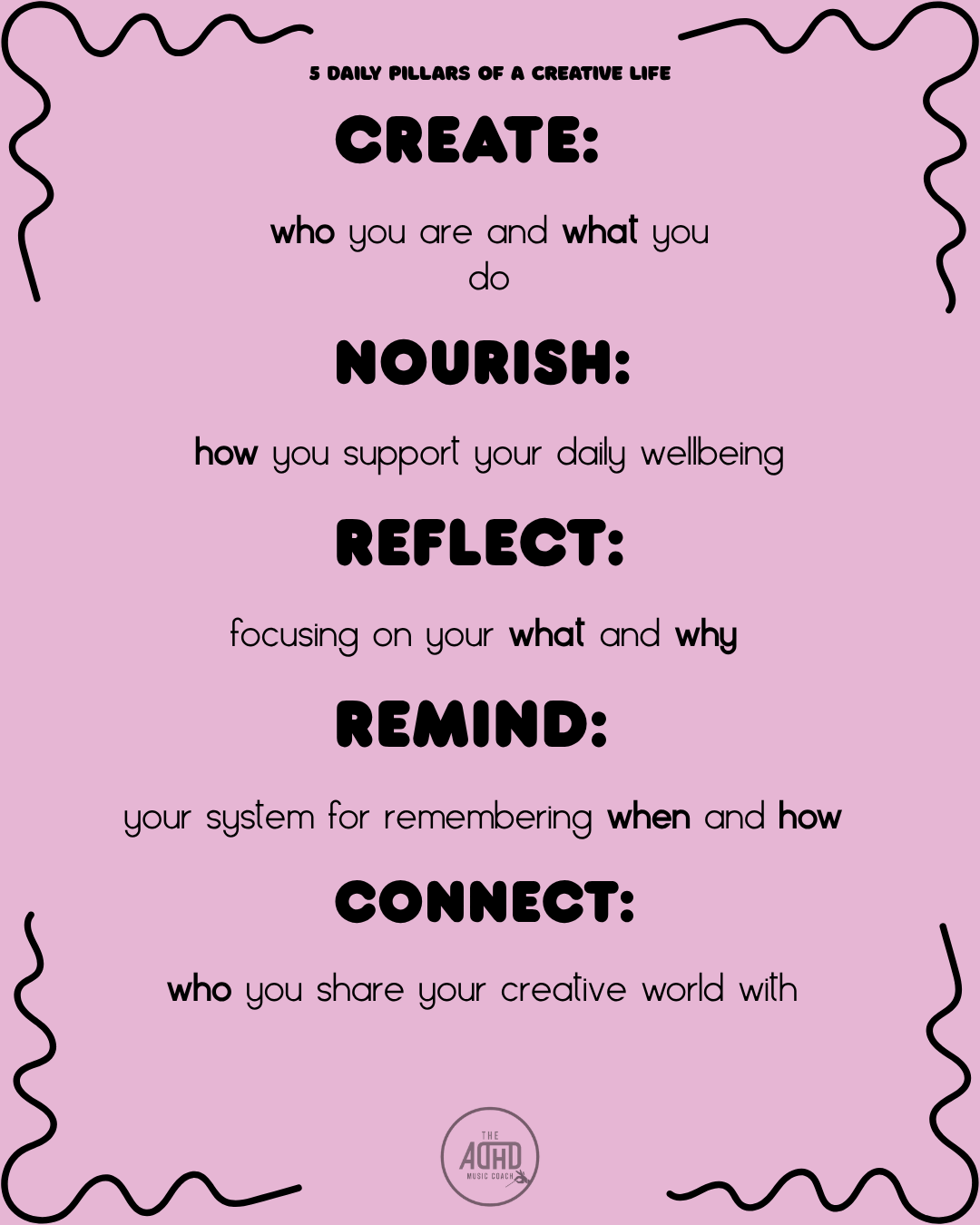
Infographic titled “5 Daily Pillars of a Creative Life” on a pink background with black squiggly borders. The five pillars are listed with short definitions:
Create: who you are and what you do
Nourish: how you support your daily wellbeing
Reflect: focusing on your what and why
Remind: your system for remembering when and how
Connect: who you share your creative world with
Includes “The ADHD Music Coach” logo at the bottom
Why I built this system
When I was studying for my second degree (pre-diagnosis) I knew I was struggling, but I couldn’t have told you what I needed. Everything felt difficult.
It wasn’t until later I understood that my difficulties weren’t laziness or lack of motivation; they were executive-function challenges: prioritising, planning, memory, emotion regulation. I’d been internalising the shame of something that wasn’t my fault.
The 5 Daily Pillars grew from recognising that same pattern in many of my clients: they wanted to know what they “should” be doing, but their internal barometer was completely mis-calibrated. They constantly felt behind or wrong.
This model gives them (and me) a macro, easy-to-grasp way of categorising behaviour and actions throughout the day to restore a sense of balance.
You can hit the pillow at night thinking you’ve done nothing, but when you check through the pillars, you realise you have done plenty, maybe you just haven’t noticed. That awareness changes everything.
Why they work
The pillars work because they reflect how we really live, not how we think we “should.”
If you’re creating - even writing a blog post instead of making your art (hello!) — you’re living your creative identity.
If you’re using reminders or systems, you’re grounding yourself in time.
If you’re reflecting, through journaling or feedback, you’re learning and adapting.
If you’re nourishing yourself — meds, movement, food, rest — you’re maintaining your creative body and mind.
If you’re connecting — with clients, peers, family, or your community — you’re keeping the energy flow in circulation.
The goal isn’t to tick boxes; it’s to recognise what’s already happening and gently rebalance what’s missing.
A day in practice
Here’s how a low energy day might look when you start noticing the pillars in action:
You wake up groggy and remember to take your meds in the bathroom because you put them by the sink with a post it note (Remind + Nourish).
A melody pops into your head, so you record a quick voice note while getting dressed (Create).
You make a coffee and chat with your partner or housemate (Nourish + Connect), jot down later plans in your phone (Remind), and check the wall calendar to see it’s not your turn to walk the dog, sorry pup! (Remind).
You have a morning meeting with your colleague (Remind + Reflect), then head to a 9:30am exercise class (Nourish + Connect). Afterward you listen back to your voice note- it’s not quite as good as you thought, but it sparks another idea (Create).
A collaboration meeting at noon (Connect) leaves you frustrated, so you journal to process (Reflect), realise it’s a communication style clash, and note that down to revisit next time (Connect + Remind). You rest for ten minutes in a dark room (Nourish) before sending a birthday message and posting on social media (Connect).
Later, you work on a client project (Create + Remind), then break your fast and have dinner with friends (Nourish + Connect). You do a quick tidy while listening to a podcast (Nourish + Remind), take your evening meds (Nourish + Remind), read a few pages of a book (Nourish), and drift off to sleep.
It’s not about doing everything- it’s about recognising that most days, you’re already tending to these areas in some way. And when you start seeing that pattern, it’s easier to spot what’s missing before burnout hits.
Why daily?
Because these are the things that quietly hold everything else up. And they aren’t just based on my own logic or experience- they are rooted in the 5 ways to Wellbeing as well as Occupational therapy principles of doing what is meaningful to you.
You don’t have to “nail” all five pillars every day- far from it. The point is to keep touching base with each one regularly, so none of them collapse entirely.
Think of them like a mixing desk for your creative life. Some days you’ll need to turn Nourish right up and Create right down. Other times you’ll be deep in Connect mode, or craving Reflect time to make sense of where you are.
The aim isn’t perfection- it’s balance, awareness, and rhythm.
These pillars aren’t a prescription; they’re prompts.
They remind us that creative lives are built on care, some flexible structure, experimentation, learning, and connection- not just on output.
For neurodivergent creatives especially, this model offers a way to design for your brain instead of fighting against it. It’s about creating the scaffolding that makes freedom possible.
In the future I’ll be sharing more about how each pillar can look in practice, with tools, prompts, and real-world examples from the AMP community.
However your week looks, the invitation isn’t to perfect a routine - it’s to stay in a relationship with your creative self through these five touchpoints.
Right, I’m off to nurture my create pillar through playing with my new midi controller!
What do you think about these pillars? Which ones resonate most?
