Prevarication, ADHD, and the problem that procrastination doesn’t explain

I recently heard the word prevarication used in the context of ADHD. It was used as a way of describing patterns of behaviour and how they can be perceived from the outside: circling, delaying, not quite answering, not quite committing. And it made me think, because prevarication is a loaded word.
In its traditional sense, it means avoiding giving a direct answer. It often carries an implication of evasiveness, sometimes even deception for personal gain. It’s a word we might use for politicians who dodge questions, or people who want wriggle room so they can’t be held to account later.
Which is why in my opinion, it feels uncomfortable to apply it to ADHD- and I’m not for the record- I’m interested in the way these behaviours can be misinterpreted and judged but I’m also curious about where this shows up in the creative or making process; where it’s just part of the neurodivergent process and where being able to use tools to get a “known” a bit quicker might be useful.
Many people with ADHD do recognise the outcome of not quite committing: the lack of a clear answer, the sense of unease it can create in others, the way it can get interpreted as flakiness, unreliability, or not really meaning what you say. Or even for yourself- how you might want to know how you feel about something but you just don’t- yet.
So what might be actually going on underneath that pattern, and why doesn’t “procrastination” cover it?
This isn’t about putting things off.
Procrastination assumes a few things:
That the task is clear
That a decision has already been made
That the issue is starting or motivation
But a lot of the stuckness I see in ADHD happens before any of that. The problem isn’t always “I know what I need to do but I just can’t make myself do it.” (although obviously it is, often!)
But this is more like:
I can’t decide what I’m doing yet
I can’t narrow this down
I can’t land on one option without losing something important
I don’t actually know enough yet to commit
Everything feels equally important or “on the table”
That’s why procrastination advice so often misses the mark. You can’t “just start” something that hasn’t been defined or chosen yet.
What prevarication looks like in real life
In myself and in my clients, this often shows up as a lot of internal activity with very little external movement.
Things like:
researching endlessly instead of choosing
preferring to rewrite lists instead of taking action
talking around a decision without landing on a next step
keeping multiple options open “just in case”
waiting for more information that isn’t strictly necessary
It can also show up as being unable to answer what look like simple questions:
What are you doing next?
When will you know?
What’s the plan?
From the outside, not being able to answer these kinds of questions on demand can look evasive. From the inside, it usually feels like being surrounded by too many possibilities to grip any single one.
What’s actually going on
This isn’t about avoiding responsibility or waiting for something better to come along. It’s about how ADHD brains handle choice, uncertainty, and commitment and few things tend to be in play.
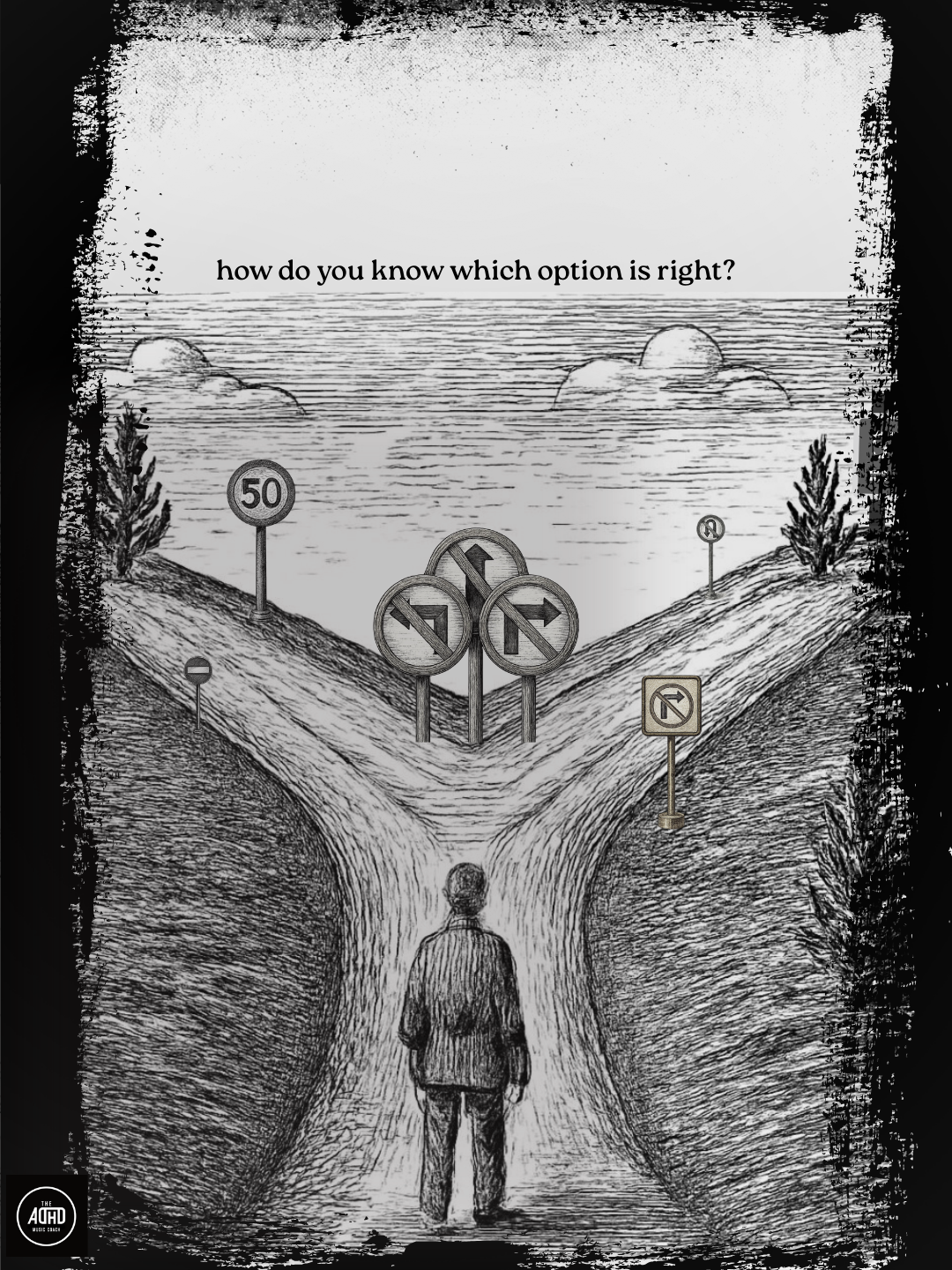
Decision closure is energy intensive
Choosing requires prioritising, sequencing, holding options in mind, forecasting effort and consequences, and inhibiting alternatives. That combination is cognitively costly for an ADHD brain. Keeping options open can feel safer than choosing the wrong thing and having to undo it later.
Premature commitment feels risky
Many ADHD people have learned through experience that committing too early can backfire. Your energy shifts, information arrives late, the context changes... So the brain develops a strategy of waiting until things feel real enough to decide.
Time doesn’t feel solid until it presses back
Until something is imminent, it can feel abstract and also potentially possible. Clarity often arrives close to the deadline, under pressure, when the future becomes concrete- “I’ll know when I know”. And it’s often proving a negative- I don’t have time to…x now- which is just clearer at the sharp end. (Which is taking things off the figurative table)
Relational-stake jam articulation
If a decision involves inconvenience, asking for something, or risking being “too much”, the question itself can get stuck. I’ve seen this in clients and in my own life: the answer isn’t withheld, it never quite forms because we are not used to taking up space for ourselves.
I find I notice these signals more in myself and clients in the lead up to a performance or event. There is a sense of not knowing until you are forced to know through a time deficit/forced narrowed options. Our brains are adept at keeping all the options on the table because it’s possible that we could develop parts to use in a set (for example)- until it’s clearly not possible anymore because you realise wow I DEFINITELY don’t have time to get this bit finished.
I have also experienced people with ADHD giving presentations where they have not settled on their final output- (because everything is important to say and then you think of new things to add in- right?) but it means they don’t get to cover the important bits they needed or wanted to and can feel frustrated with their performance as a result- rushing towards the end or even getting told they are over time and have to stop. It happens!
We can have difficulty closing the loop until the moment demands it- and it’s not wrong- it’s the way we are wired. It also depends- being fluid with your process might be more important than having a polished output- the issue is whether you need or want something different- for yourself.
Why this gets read as flakiness and what to do about it
What others see:
delayed answers
non-answers
last-minute decisions
apparent passivity
What they don’t see:
the cognitive load
the parallel processing
the internal contingency planning
the cost of choosing wrong
So the behaviour gets labelled as vague, unreliable, evasive. And over time, that gap between intention and perception becomes a source of shame. I think it’s ok to say something like I need a little more time to process things or might need the information to be communicated in a different way or would it be ok to discuss options and when do you need a definitive answer by?
Why clarity often arrives late
ADHD brains often decide best with constraint.
That might be:
time pressure
external structure
embodied context
narrowed options
another person asking a very specific question
Once the field collapses from “many possibilities” to “this or that”, the decision can finally land. It’s the point at which the brain finally has enough information and containment to commit.
This is why song choice or order for a gig often only becomes clear when you get close enough to feel the room, your body, your voice, the emotional arc. Before that, the information genuinely isn’t there yet.
So what actually helps
This isn’t about forcing decisions or pretending uncertainty doesn’t exist. It’s about reducing the cost of commitment so your brain can consider your choices with less noise.
Things that often help:
shrinking the decision: what’s the smallest version of this I could commit to?
replacing open questions with closed ones: which of these two is least wrong?
using provisional language: “my current best guess is…”, “unless something changes…”
externalising the decision by talking it through with someone who can help you land
defining “good enough” in advance so the finish line exists
making choices reversible where possible: try it for a week rather than decide forever
And sometimes the most important thing is simply naming the uncertainty out loud, rather than disappearing into a vortex.
So is prevarication the right word?
Maybe descriptively. Probably not actually.
What often gets called or seen as prevarication in ADHD isn’t deception. It’s difficulty committing under uncertainty. The outcome can look evasive, but the cause isn’t evasiveness. It’s a nervous system waiting for enough information, safety, and constraint to choose something it can actually stand behind.
Naming that difference matters. Because when we call this procrastination, the answer is framed as needing more pressure, better will power or imposed discipline. When we understand it as a decision-making problem before action, we can respond with structure and a plan instead of shame.
And for many people, that’s what finally allows things to move.
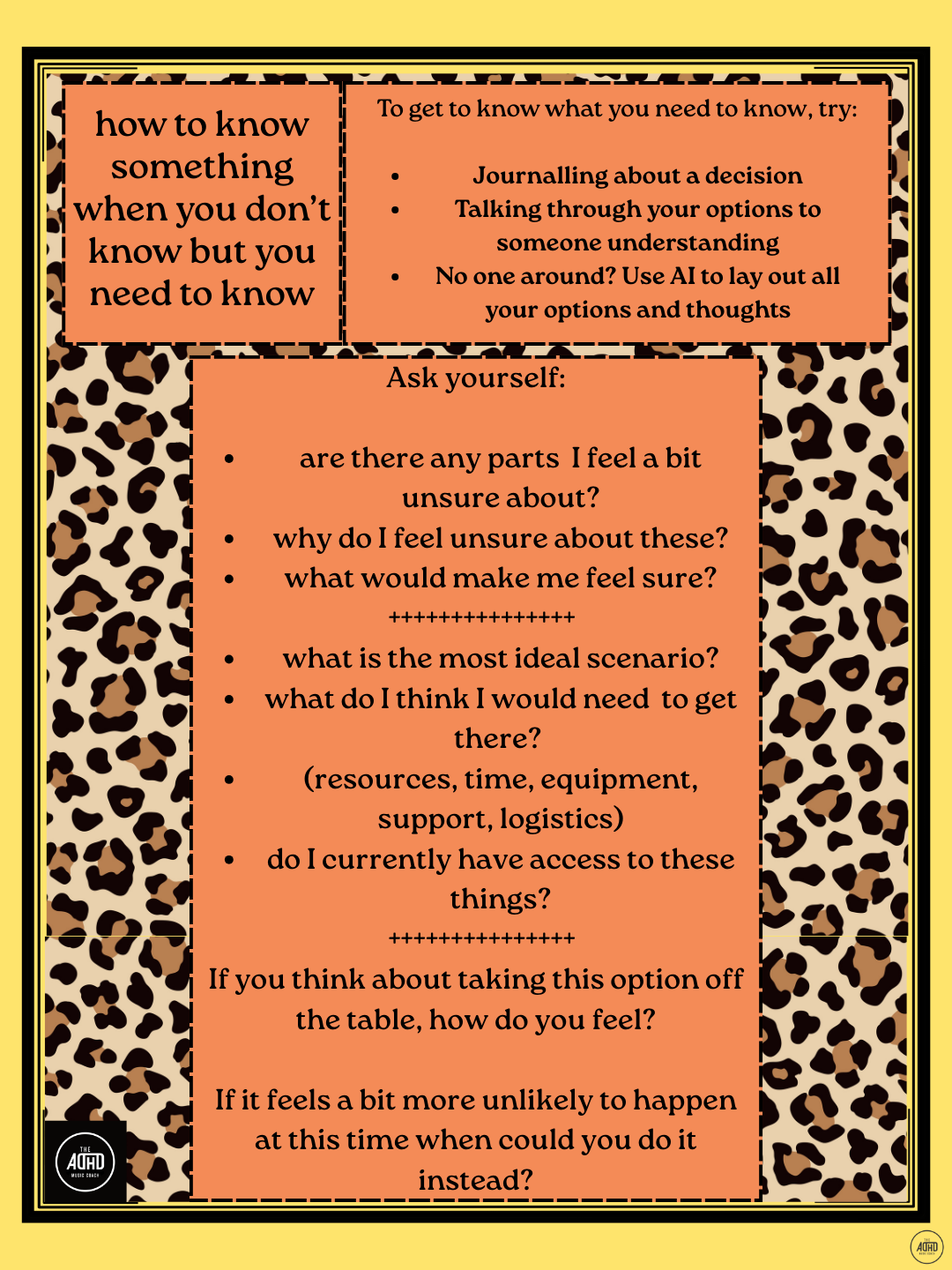
To get to know what you need to know, try these quick fixes:
Journaling about a decision
Talking through your options to someone understanding
No one around? Use AI to lay out all your options and thoughts
Or ask these clarifying questions…
Big picture questions:
What is the most ideal scenario?
What do I think I would need to get there? (resources, time, equipment, support, logistics)
Do I currently have access to these things?
Could I get access with the time available?
Action/Outcome: Assess your resources to make your best case scenario happen or find your second best scenario…
If you’ve got a big decision to make, ask yourself:
Are there any parts I feel a bit less sure about or things I don’t know?
Why do I feel unsure about these?
What would make me feel sure?
What might feel or be better instead?
Action/Outcome: Find out something you don’t know
Do some Subtraction:
If you think about taking this option off the table, how do you feel?
If it feels a bit more unlikely to happen at this time, when could you do it instead?
How does it feel to take this option away- for now?- is it tolerable?
Action/Outcome: Permission to say “not yet” to something
Put down roots:
Is there a time deadline when you feel you should or could commit to your output?
What would sticking to this deadline give you? (eg- comfort, certainty, disappointment?)
If it would be helpful to your process, how can you make sure you stick to this? (telling people publicly, calendar reminders, body doubling, coach, manager/ friend?)
If you follow through on this idea can you check in afterwards and decide if it helped you?
