The “Making vs Finishing” Gap… and how to bridge it
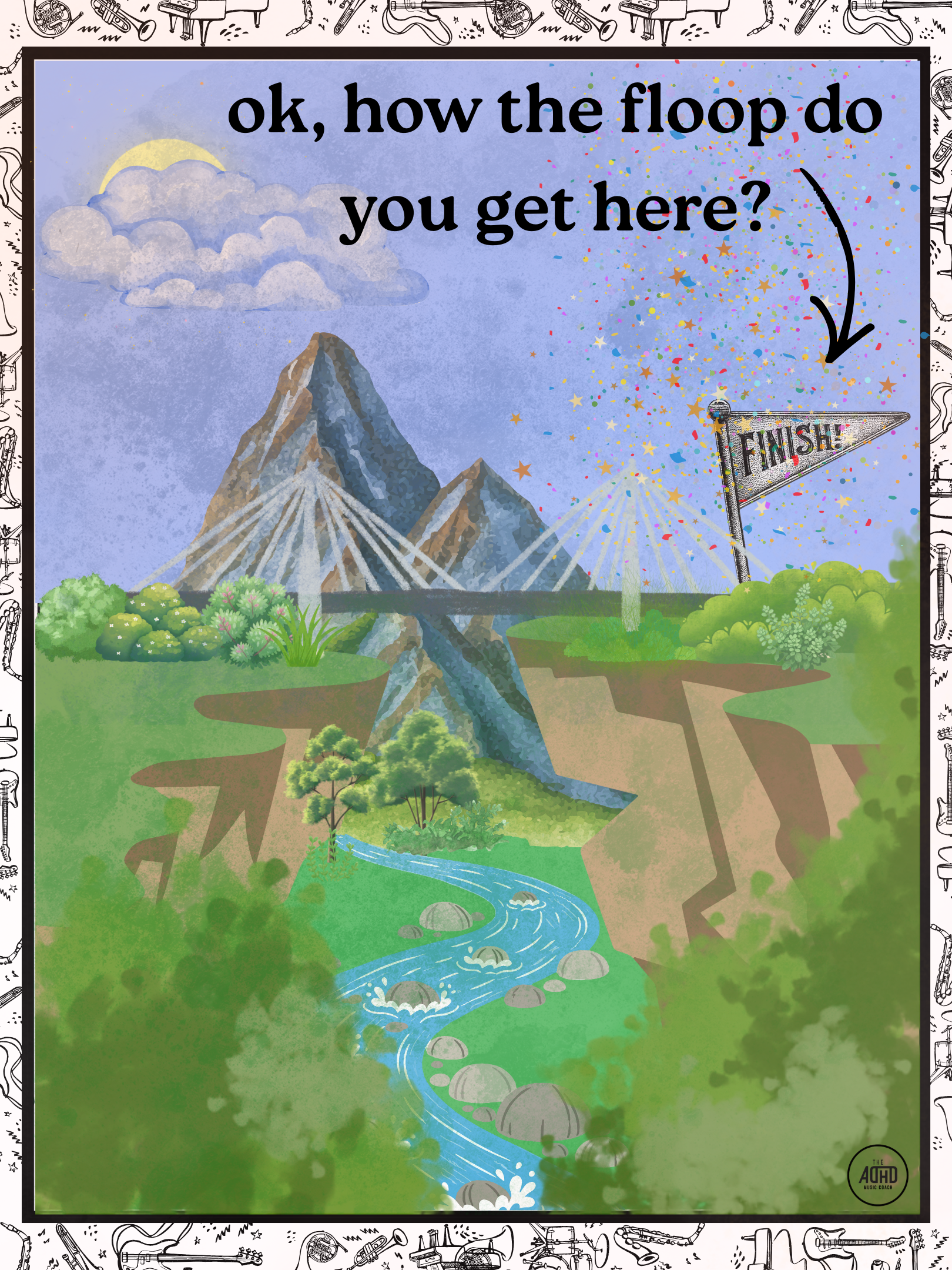
We’ve touched on versions of this before, especially around having lots of ideas and being good at starting things, but ending up with fewer projects actually seen through to completion.
This isn’t a problem in itself, being an ideas machine can be such an asset. But it does mean that getting things over the line often requires a different skillset and a different kind of structure, one that may not come naturally or even occur to us.
If we don’t recognise that, it’s easy to slip into self-criticism and assume we’re doing something wrong. When we understand that finishing is a separate phase with its own demands, we can enter it more consciously and stop judging ourselves for finding it harder than ideation.
One of the most common frustrations people bring to coaching is “not finishing things”. Sometimes this shows up as a vague sense that you don’t actually know how to get to the end of something, how to refine and polish it in the way it needs. Other times it’s very specific. There is one thing you want to get over the line and you just can’t seem to do it.
What does this look like in practice?
Half-finished songs at various stages
Ideas that have never been shared
Multiple pieces that are 80% done
Projects called “finalfinal27”
Extensive notes on what a project needs to be finished, with no action taken
Finishing can feel scary. People often talk about fear of failure and fear of success, and both can show up as perfectionism or procrastination. But there are also less obvious reasons this stage can be particularly difficult for neurodivergent people.
We often internalise the idea that “if you cared enough, you’d finish”. Before we understand that finishing genuinely asks more of us, we can turn that belief on ourselves and assume we just don’t care enough about our work or our creativity.
Sounds convincing based on output but it’s also wrong.
“Finish something” …hmmm, it’s giving “that’s simple!” vibes but it’s actually a complex bundle of tasks and demands, and there are many points where things can fall apart.
The executive function load
Finishing places heavy demands on executive functioning, including:
task initiation
sustained attention
sequencing
prioritisation
cognitive flexibility
working memory
The early and middle stages of making often feel novel and exciting. They don’t require much order, and they allow for jumping between ideas. Finishing demands the opposite.
The Dopamine thing
Yes, that old chestnut- In ADHD especially, dopamine is released by novelty, interest, and urgency. Once something becomes familiar or procedural, dopamine drops.
So:
starting is chemically rewarding
continuing is often neutral
finishing can be under-stimulating and effortful
Shutting something down
Finishing requires closing options:
choosing one version
committing to a form
saying “this is it”
Neurodivergent cognition often sees many valid possibilities, struggles to rank them, and finds it painful to discard ideas. This isn’t indecision so much as an overload of equally compelling options. Hello again to our old friend prevarication.
From private to evaluated
Finishing moves work from private to potentially evaluated. That shift can activate:
rejection sensitivity
shame memory
fear of misinterpretation
threat responses linked to past criticism
Even imagined feedback can trigger freeze, avoidance, or a sudden loss of emotional connection to the work. At that point, the nervous system often steps in to protect you.
“If we don’t finish it, we can’t be hurt by it.”
From the inside, avoiding exposure can feel safer than completing the work.
Perfectionism as protection
Clinically, perfectionism often functions as:
an anxiety management strategy
a way to delay exposure
an attempt to control outcomes
For neurodivergent people, this is often learned through being misunderstood, receiving inconsistent feedback, or masking to avoid negative consequences.
So “not finishing yet” can really mean:
“I’m not safe enough to stop adjusting this.”
Time perception and the cliff edge
Many neurodivergent people experience:
time blindness
difficulty sensing progress
trouble distinguishing “nearly done” from “halfway”
Without clear external markers, finishing can feel sudden and overwhelming, like stepping off a cliff. The brain doesn’t always register completion as a real, gradual state.
Task completion grief
This is talked about less, but it’s very real.
Finishing can involve:
a loss of identity with the process
grief for what the work could have been
a sense of emptiness after hyperfocus and routine
For people who regulate through creativity, this can feel destabilising. Avoiding the ending can be a way of avoiding that drop.
Context switching costs
Finishing often requires switching modes:
creative to administrative
expressive to technical
intuitive to evaluative
Neurodivergent brains tend to pay a higher cost when switching contexts, which makes the final steps feel disproportionately hard compared to their size.
The identity tension
Making can feel identity affirming- we are actively doing or living our creative identity. Finishing can make us confront the next phase eg maybe marketing or performing which we may be less sure of.
Finishing:
invites judgement
collapses possibility
forces a choice
turns potential into something people can react to
This can be particularly intense for musicians, artists, neurodivergent creatives, and people with a history of rejection sensitivity.
The Social connection
Finishing is also social, even when you’re alone. You imagine an audience, future you, and what this work might say about you. That imagined social layer can be enough to freeze progress.
While something is unfinished, it can still be anything. It still holds hope. Once it’s finished, it’s fixed in time, and that can feel like a loss.
Finishing needs structure more than inspiration. People get stuck waiting to feel ready, motivated, or confident, but finishing is often boring, procedural, deadline-driven, and externally scaffolded.
What is finishing anyway?
Finishing isn’t about ideas. It’s about decisions.
Which version?
What stays and what goes?
Is this good enough for now?
Decision fatigue isn’t the same thing as a creative block.
Top tips to finish things:
Separate maker mode and finisher mode.
Stop asking the maker to do the finisher’s job. In music you might separate a production into something like:
ideation, arrangement/recording, editing, mixing and mastering and this can be helpful for a brain that’s always open to tweaking things- if we accept a stage of the process is over- eg it has all the ideas in it you will want then we just need to work on cutting down/editing or perhaps you’re at the mixing stage- so state that to yourself and enter that mode.
It can help to enter the next stage by saving a new project with the phase name so you’re keeping it clear- eg song2_draft mix.
Finish for a purpose, just for now, not forever.
Lowering the stakes makes finishing more accessible- you might want to finish something just for… now or for a specific deadline or job- but you’d be surprised how often just for now edits get used as the thing. It’s good to aim high but if it’s stopping you from reaching a helpful level of output then finding a place in your mind where just for now works then try it.
Borrow structure from outside yourself.
Deadlines, body doubling, accountability, mentors, coaches, frameworks, and checklists are there to be used. If you knew how much support other people use to help them you’d be wondering why no one told you sooner- I’m telling you now! This is why ADHDers love a live course- it forces us to learn with external accountability and provides a container for attention and focus to get us towards our goal.
Define what “finished” means, practical and personally.
I’m 100% sure you have something that is near completion on your hard drive- what would it take to get this over the line- not perfectly but the bare minimum? When could you do it? What would it mean to you to finish this? How and when will you get it finished? Who or what will support you with finishing this?
We often think we can’t finish things… but when you look at the flip side- that many people can’t generate interesting or creative ideas- it doesn’t seem a failure at all- more a moment where we might need to borrow support, structure and accountability.
Accepting that is, in my opinion, one of the best things you could do for yourself today. (actually finishing something you want to finish would be great too of course! )
If you’re interested in one to one coaching with me or joining my live accountability membership The AMP Club, get in touch! I’d love to support you with finishing something this year.
