Systems- still looking for that perfect one? look no further! (because there isn’t one)
Still waiting for the perfect system or routine that sticks?
Here’s what you need to know and why neurodivergent brains need something else.
I see you with the whiteboards; the sticky notes and the backlog of planners full of hopeful potential. No shade. I love stationery solutions myself (I’m only human!).
I also often think:
“Oh, ok THIS is the one thing I need that will FINALLY make everything work for me FOREVER!”
But I’ve learnt an important lesson about systems.
There isn’t a perfect one.
Why?
• Many solutions rely on a neurotypical brain to sustain them
• We need different solutions for different scenarios and environments
• What works for my brain is totally different to what works for yours
• Our relationship with novelty means we will always need new or alternating solutions
• When systems stop working, it’s usually about neurotype, not willpower
If we expect systems to expire, we can be ready with the next solution without self-recrimination.
The one thing we usually are is inconsistent, so why do we expect to stick to one system or one routine consistently?
Why “good” systems stop working
Visual systems like cork boards, whiteboards, wall calendars, screen based reminders, sticky notes, labels and digital alarms can absolutely be part of your toolkit.
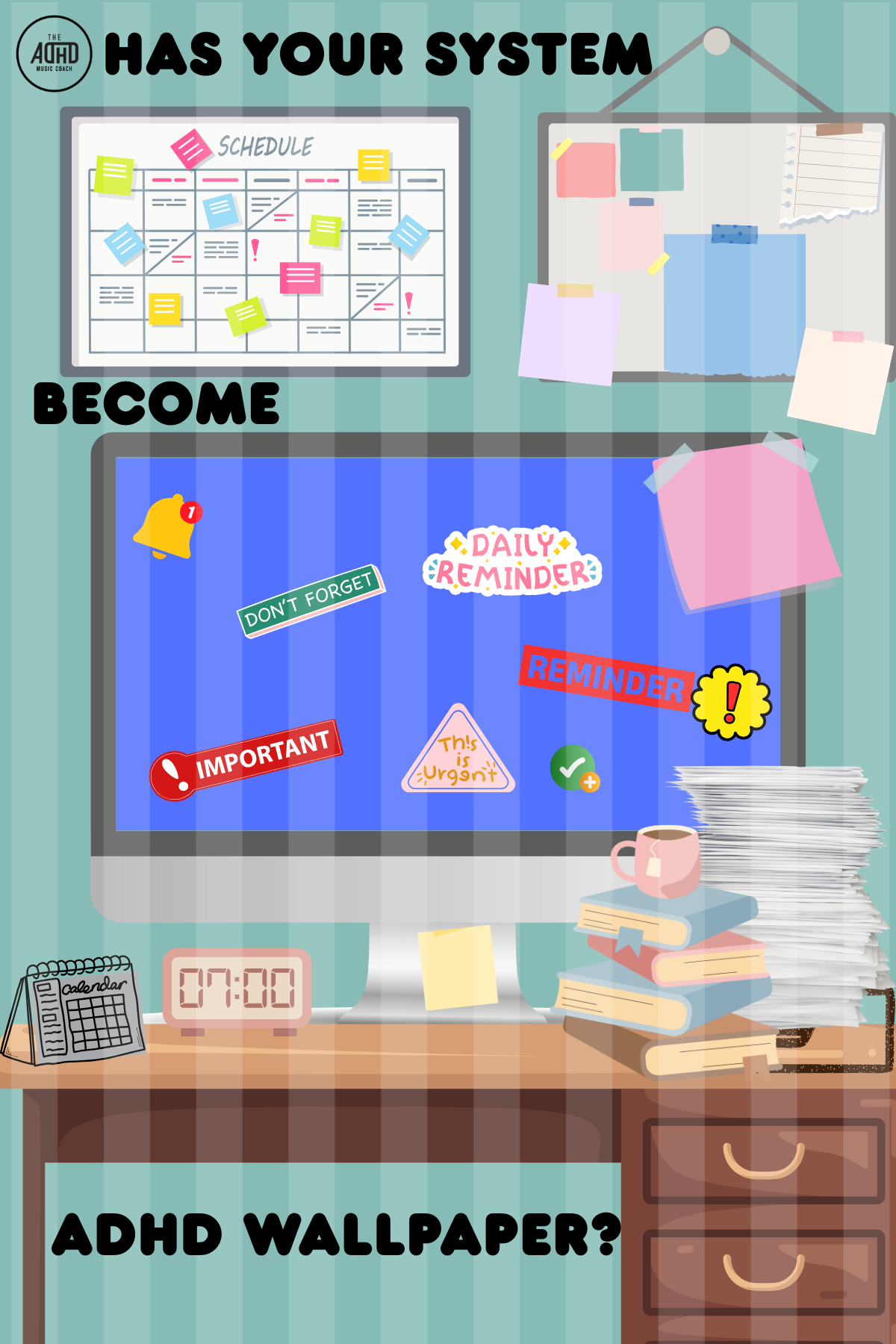
But many people experience the ADHD wallpaper effect. Things become part of the furniture.
That bright pink post-it that once reminded you to grab your keys disappears from your awareness. Calendar notifications go off so often for “go to the gym”, “read that book”, “drink water” that you stop responding at all.
These are systems that should work, but don’t when they aren’t being used efficiently or consciously anymore.
What works instead
Rather than one perfect system, most neurodivergent people need a patchwork of strategies that flex with context.
Environment and time based mini-routines
Routines that kick in when you enter certain places or moments.
For example, a bedroom at night triggering a sleep wind-down, or taking medication when you make your first hot drink of the day.
Task batching
Grouping similar tasks together to reduce friction and transitions.
For example, doing self-care activities together in the morning, or keeping different creative tasks like instrument and voice practice in the same block and environment.
Habit stacking
Adding something new onto something you already do.
You probably brush your teeth every day, so that’s a good anchor for a visual cue for medication, supplements, or even something aspirational like ten squats.
Involving other people
One of my favourite system hacks is involving other people.
When something slips out of working memory, shared accountability can keep it alive in a way solo systems often can’t.
When systems go wrong…
Sometimes my system goes on holiday, usually when I do.
Sometimes you can get caught up in completing the admin of a system and forget what the point of it was.
Sometimes something works really well, like journalling, and then… it doesn’t. You might be able to tweak it and reinstate it. Or it might be that the routine did its job and is no longer serving you.
The real question is: what is the point of the thing?
Knowing the why matters. Without it, there’s nothing to connect motivation or interest to.
Ask yourself what you actually need and what you’re trying to achieve. Is the outcome something you want or something you think you should do?
“Meditation would be good for me” is rarely enough. Instead:
“I want to see if engaging in regular mindful breathing helps me regulate my emotions and physical balance so I feel more resilient” is more specific and easier to commit to.
Adding another person, like a live class or practitioner, often makes it more likely to stick.
A useful system also supports different kinds of activity.
Nourishing your physical/mental/spiritual health.
Being reminded of what you need to do.
Reflecting, auditing and adjusting- alone or with others.
Connecting with people.
Creating.
The goal is doing what you need or want to do at a time and place that actually suits you.
What actually works for many people
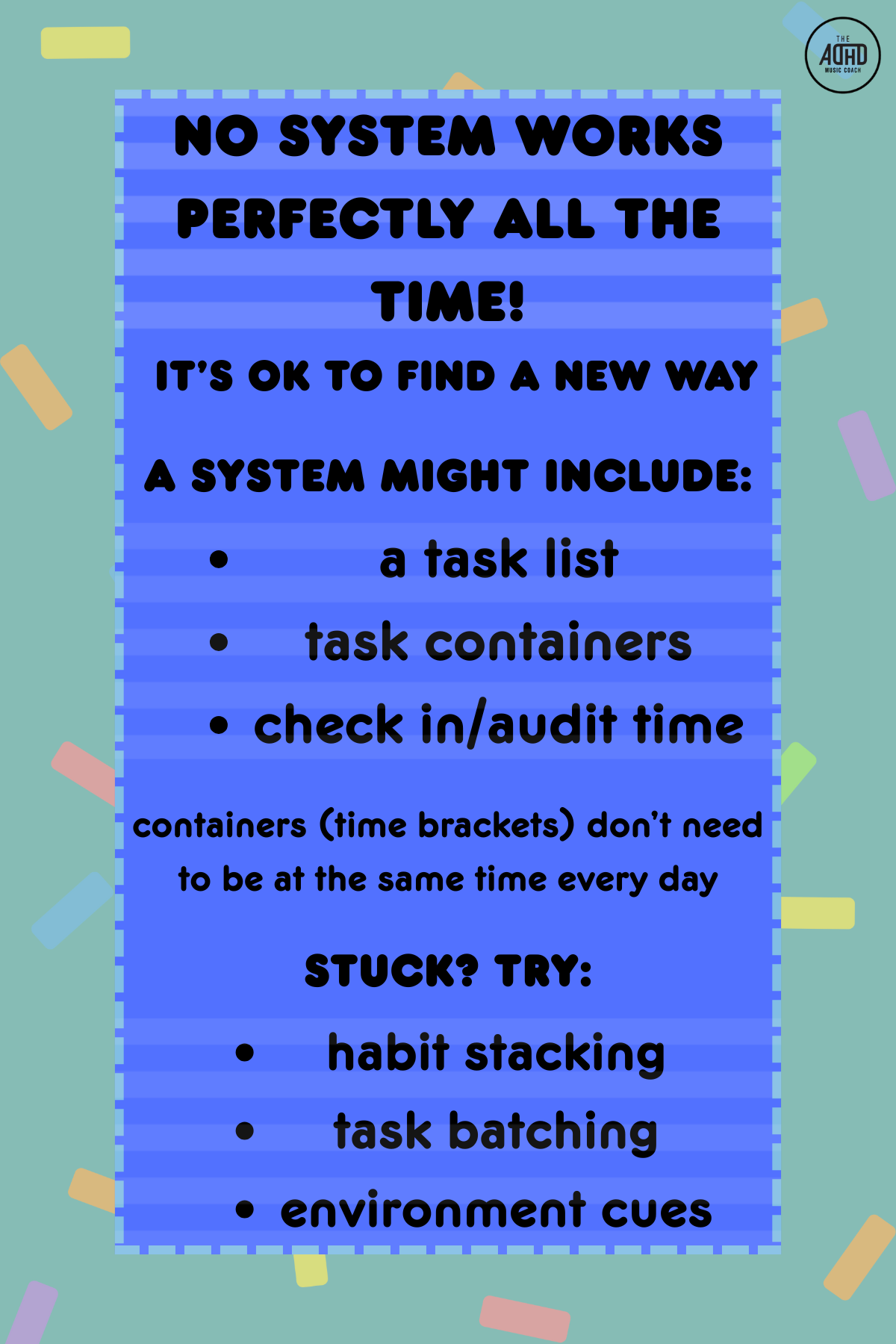
• One place for tasks (to do list system- eg ios notes/ whiteboard/ paper diary)
• Low-stakes routines (a mini version still counts- eg practice for 5 mins vs 1hr)
• Containers instead of discipline (create the time/place/people to make it happen)
• Micro-habits (mini tasks, mini actions eg opening a folder, having a glass of water)
• Messy consistency (non linear- keeping a thread going)
You know yourself and your brain best- even if you don’t think you do
I have one client who always writes their task lists on scraps of paper. It doesn’t matter how effective I think ios notes is as a to do list system- if they will never use it or carry one notebook with them everywhere… then writing on scraps of paper is part of their system and actually their system works for them, alongside other forms of accountability (like coaching and AMP club/other community support).
So my top tip to neurodivergent creative folk who may be thinking I just haven’t found the right system yet is:
you know yourself best- you’ve survived this long and have probably done reasonably ok in different areas of life so you probably have a lot of the answers yourself.
If I could give you one gift this year it would be to help you see you don’t need to find the perfect system- you are already incredibly knowledgeable about the way you are. We are just used to viewing and doing things in the inconsistent way we do as negative or lacking somehow compared with neurotypical standards.
If we actually accept ourselves the way we are then we can start to work with how we actually are- not how we think we are supposed to be.
What do you use to organise yourself? How do you know and remember the things you need to know and remember? What tools or strategies are working for you and what might need a bit of a refresh?
