How to set Goals (when your brain doesn’t vibe with planning)
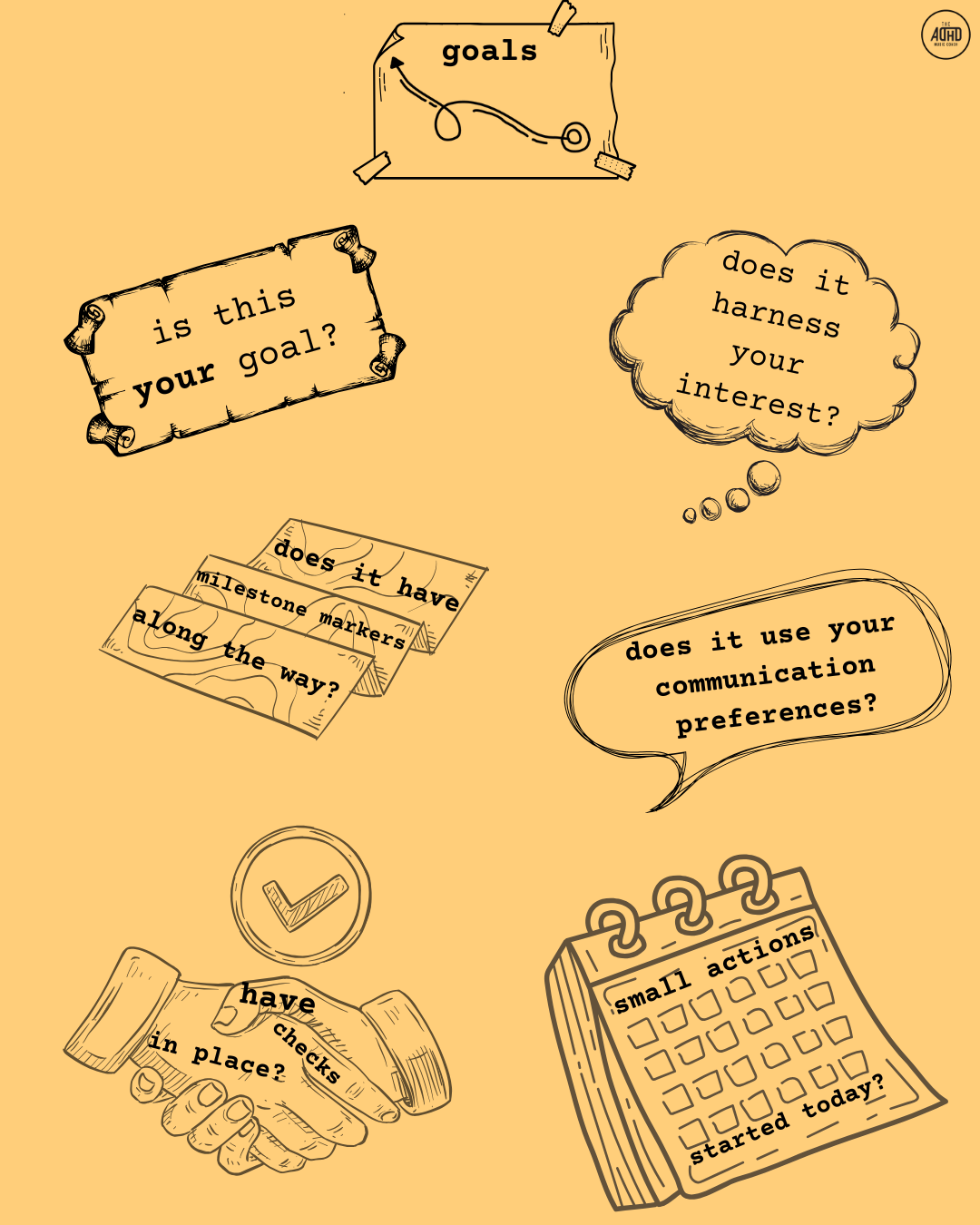
Hand-drawn illustration on a mustard-yellow background featuring reflective prompts about goal setting, including questions about personal interest, milestones, communication preferences, check-ins, and starting with small actions.
Setting goals is one of those things that comes up everywhere, especially at certain times of the year. It is often presented as something simple and motivating, but for a lot of neurodivergent people it can feel both vague and conversely pressurised.
Having to set goals can activate feelings of low self worth (I will never achieve these so what is the point) and even trigger feelings of resistance to authority, (even if the authority is future you). If you have ever endured an enforced goal setting exercise and felt somewhat angry as well as sad, you are not alone.
I made a goal setting resource recently because I kept noticing the same pattern in myself and in my clients. It is not that neurodivergent people do not want to achieve things. The way goals are usually framed does not match how our brains actually work. We often think we are doing it wrong or that we are the problem- again. But if we approach goal setting with what we know works for neurodivergent brains, (or our own brain more specifically), then we can finally start to make progress with what we want or need.
For many of us, the issue is not a lack of ambition. It is knowing where to start, how to break things down, and how to stay connected to a goal once the initial interest has faded.
Like with most things in life, successful achievement of goals needs a solid support system:
Work out what you want, why and when you want to achieve it by
Identify smaller steps, goals and milestones along the timeline
Plan these milestones in your diary, + time to work towards them and checkins with others.
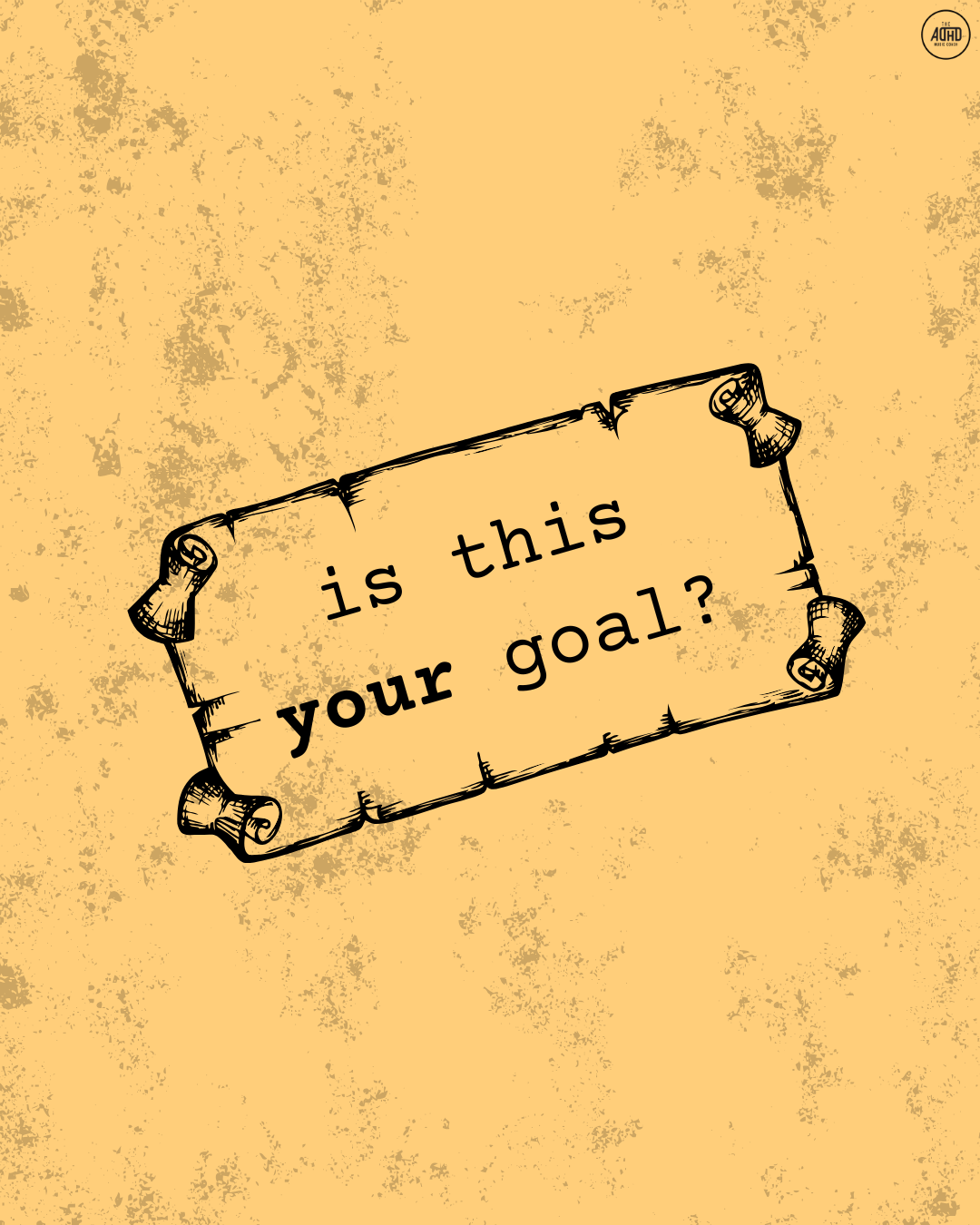
Motivation and the problem with “should”
It is really important to understand your why. Why are you interested in achieving this goal? Do you actually want this? Or do you think you should want it because you have heard it would be good for you?
Sometimes we do not know what we should be doing or achieving, and it is ok to try things out. But “because everyone says it is good for you”, is rarely motivating enough to sustain you through achieving a long term goal. If you are unsure about your motivation and know this might be an important factor for you, the 5 Whys exercise can help you uncover your personal reasoning.
Why traditional goal setting does not map neatly onto ADHD lives
A lot of traditional goal setting assumes you can clearly separate your life into neat categories and move steadily from intention to action. In reality, things overlap.
Your energy affects your creativity.
Your environment affects your motivation.
Your mental and physical health affect everything.
That is why I often look at goal setting through three lenses: you, your thing, and your environment.
“You” includes your mental and physical health, your capacity, and how your neurodivergent traits show up. Goals in this area might include learning more about yourself, personal development, physical health, or experimenting with routines and habits that support you.
“Your thing” is the creative work or focus itself, what you want or need to do next. In occupational therapy this would be your occupation or activity, meaning the work that is meaningful to you. A creative goal like producing your own track might involve equipment, skills, knowledge, and time. Career goals might include submitting songs for sync or collaborating with other artists or producers.
“Your environment” includes the social and physical conditions around you and what support is or is not in place. This could mean physical space, like creating a workable setup at home or finding a shared studio. It can also mean social/ financial support, community, childcare, or renegotiating home life responsibilities so your goals are actually possible.

Why “do the thing” goals do not work
One of the reasons goals can feel meaningless is that they are often reduced to big outcomes we can’t achieve easily, which can be kryptonite to ADHDers. Finish the project. Practise more. Be consistent. These statements hold a lot of expectation and judgement and on their own do not tell you how to get there. We are so used to talking to ourselves this way and wondering why we can’t “just do it” that one of the kindest things you can do for yourself is (in my opinion) to recognise the places where you are telling yourself to “just do the thing” when you are probably only doing one small part of the thing- because that’s all you can do, right?
In my experience, “do the (big) thing” is a default mode for many ADHDers. Even when we know, the instinct is to jump straight to telling ourselves something like “write new song” and forget all the component parts (I still do it myself!).
There’s a word for this and it’s called: task lumping
Task lumping is the tendency to treat a complex, multi stage process as one single task, to hold the whole thing in your mind at once, and to skip over the component steps.
So instead of:
Brainstorm
Draft
Refine
Edit
Finish
The brain labels it as:
Write song
The cost is that you do not know where to start, you do not see progress, and everything feels unfinished and therefore like a failure until the very end.
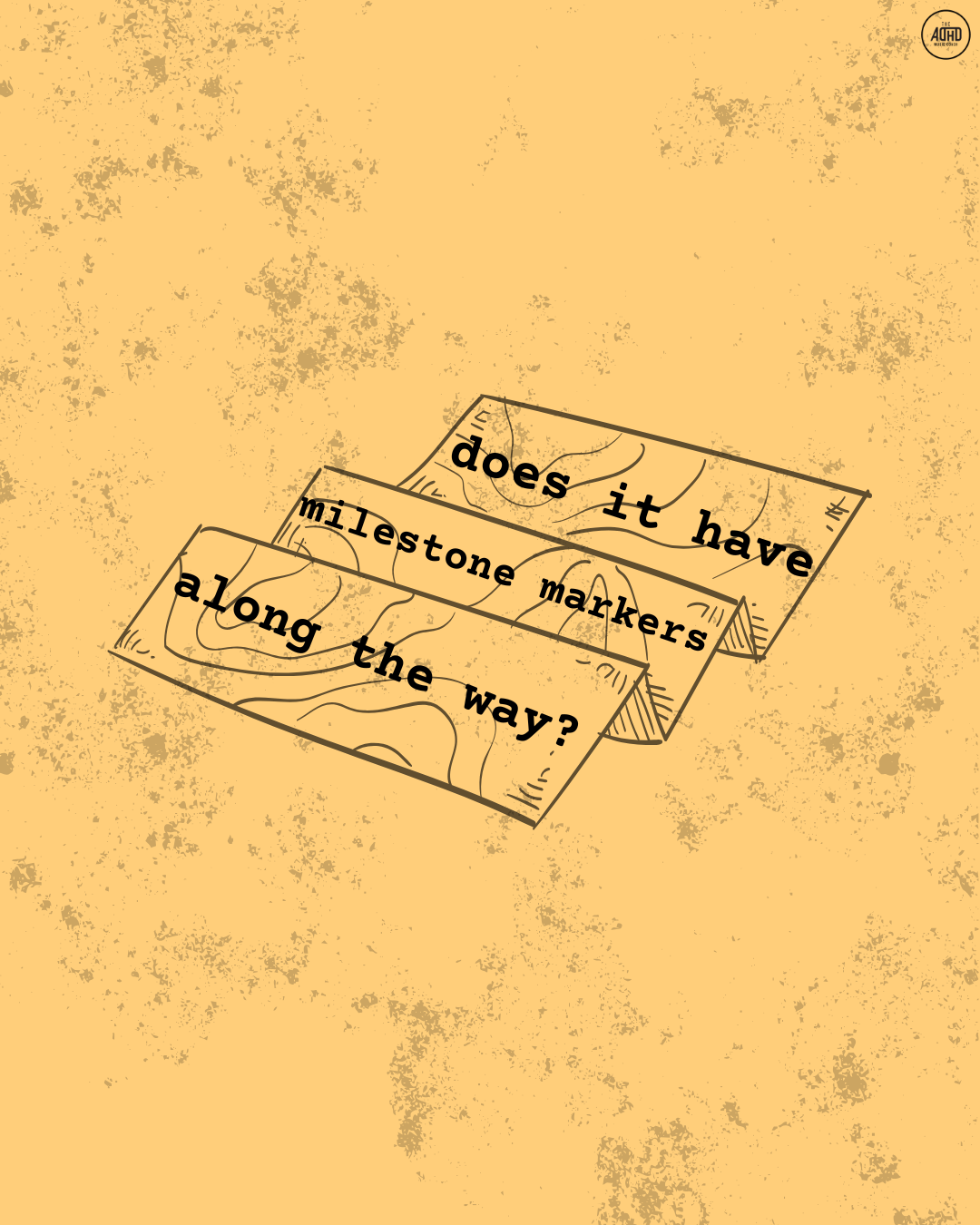
Only Big Outcomes Count:
A constant companion to task lumping is Only Big Outcomes Count or ‘outcome only’ framing. This is when the brain values only the final result and dismisses partial progress as meaningless with no value. I see this a lot with ADHDers and it’s something we need to catch ourselves doing and give ourselves a bit of recognition for what we’ve done so far- why? Because we often default to not remembering what we’ve achieved anyway… and can suffer with fluctuating self esteem as a result- if we can resort less to big outcomes only thinking and see the small bits of progress we are making, well, this is how we achieve goals and not give up on them. We can learn not to be disappointed we haven’t played the pyramid stage at Glastonbury (yet!) and recognise we took a step to get a gig at a local venue and made some more contacts. I had several clients last year who actually thought they had made no progress with their goals and it was a pleasure to see them realise the tiny places where they had moved, or made a decision about something which is all progress.
Here’s an example of the component parts of a goal we often ignore:
Writing half a verse does not count.
Sketching ideas does not count.
Learning the chords does not count.
Only a finished song counts.
Prioritising and Goal compression
A thing called ‘Goal compression’ gets involved as well. A long term goal, a medium term project, and a short term action all collapse into one. Write an album. Write a song. Sit down with Ableton. They can all feel equally big and equally urgent. We can struggle with time management and prioritising and our nervous system can respond with overwhelm, avoidance, or not committing at all. This is where breaking a goal into it’s component parts or things you need to do to get there can be helpful- I find I don’t think chronologically naturally (though I might need a chronological list at some point) but I normally use a blank piece of paper and just write down everything to do with the goal that I’m thinking about then I’ll scan it and look for something that piques my attention- maybe I want to try using a new soft synth or plugin and that’s my interest based starting point, maybe I have some lyrics I captured in my notes app and want to start there and see if anything else is inspired. Or maybe it’s really important to start at the beginning and perhaps that is only clear when you’ve identified all the tasks you might need to tackle. When I’m feeling overwhelmed about how to do something a blank piece of paper is my friend- or I use iOS notes app if I’m out and about.
“Write a song” broken down properly
Lumped version:
Write song
This feels huge, vague, emotionally loaded, easy to avoid, and impossible to tick off.
A very basic decompressed version might include:
Listen to voice notes
Choose one idea
Find a chord progression
Write a rough verse
Experiment with further sections
Record a scratch demo
Each of these is a legitimate task. Each can be recognised. Each can generate momentum. But unless they are externalised, the ADHD brain tends to ignore them.
The time pressure thing is definitely a thing…
We might also only be used to achieving goals (like writing a dissertation, a song or meeting a project deadline) with immense time pressure and can find it hard to achieve a goal without it. It’s ok to always have a natural surge in interest, focus, energy and motivation towards a deadline- them’s the brains we’ve got!- but the idea is that we get better at building in some awareness and externalised pressure throughout/before the build up. This helps us to dissipate the extreme stress that can come from having to give it everything you’ve got at the end- because yes, we can do it… but getting more support with our goals earlier is probably less stressful- we are just not used to knowing that we need this!
What actually helps
Naming and externalising the component parts so the brain can see progress, release dopamine, and locate where you are in your goal journey.
In the resource, I focus on three things that help goals stay alive:
1. A clear vision or ambition
2. Identified milestones
3. Regular check ins
This is not about being rigid or productive for the sake of it. It is about giving your brain something it can actually work with.
If goal setting has always felt uncomfortable or demoralising, that does not mean you are bad at it. Often it means the goals were too vague, too compressed, or designed for a different kind of brain.
Can you think of ways to make setting goals (and reaching them) work better for you?
If you’d like to join a guided goal setting session, The AMP Club (my accountability club for Neurodivergent Creatives) has a Monthly Reset session on Sunday 4th January 2026 at 7pm (UK) where we will be setting goals for 2026- if you’d like to join send me a message and I’ll send you the link.
